Didjeing Outta Dog
Of Breath and Bark: a Morning Didjeribone Interlude in the Park
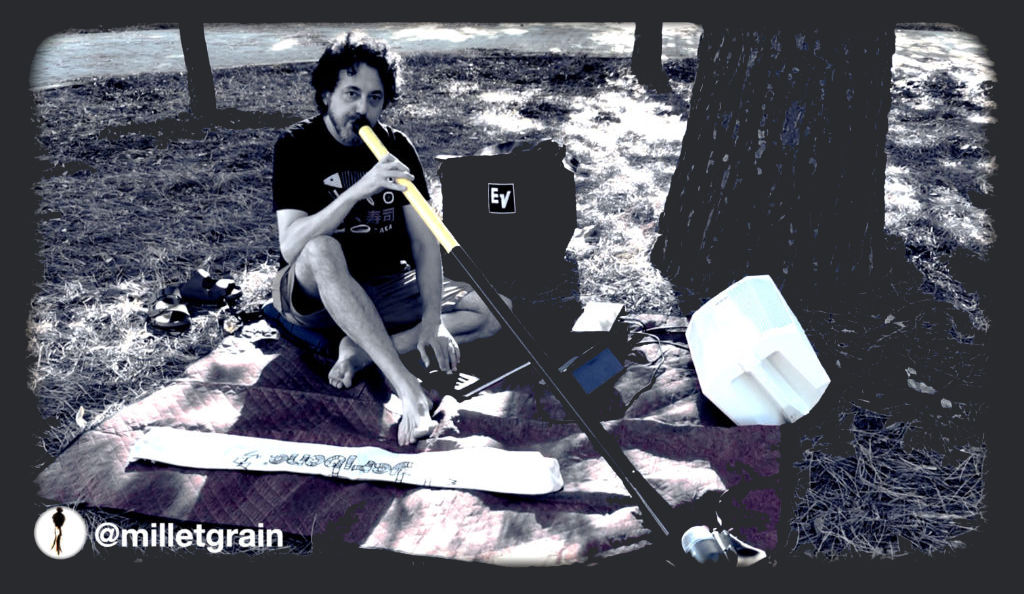
It was one of those summer mornings when time seems almost suspended: a tranquil pocket of stillness tucked inside the city’s otherwise relentless pulse. The grass was already warm with sunlight, and the air carried the scent of cut leaves and waking soil. Beneath the shade of a tall plane tree, a small group had gathered on yoga mats in quiet attention to breath and body. At the centre stood the teacher, fluid and unhurried, her posture calm enough to make the whole park feel as if it had lowered its voice.
Just beside her, I found my place — not to stretch or pose, but to add sound to the space. In my hands was a Didjeribone, Charlie McMahon’s slide didgeridoo: a modern, pitch-shifting cousin of the traditional drone instrument. Its sliding body allowed me to move through tonal centres while keeping the breath alive, deepening the dialogue between vibration and movement. The first tone emerged slowly: a long, low drone, textured and earthy, rising like a hum from the ground itself.
Around that drone I layered a soft weave of percussion and ambient pulse — something between dry leaves, distant footsteps, and a heartbeat remembered from far away. Each breath into the Didjeribone stretched time a little further. The notes were not trying to go anywhere; they simply stayed present, like the practitioners reaching toward the sky in quiet determination.
For a few measures, sound and body felt aligned: breath in rhythm, motion in stillness, mind at rest. It was as if the entire park had entered a gentle, unspoken pact of peace.
Then, without warning, a large stray dog burst into our serene little world. Tongue lolling, coat tousled, bark booming with all the authority of a self-appointed park official. He was not angry — only loud, insistent, and perhaps convinced that the silence had gone on quite long enough. In a moment, the spell broke. A mat rustled, someone laughed nervously, a bird took flight. The world returned to its usual entropy.
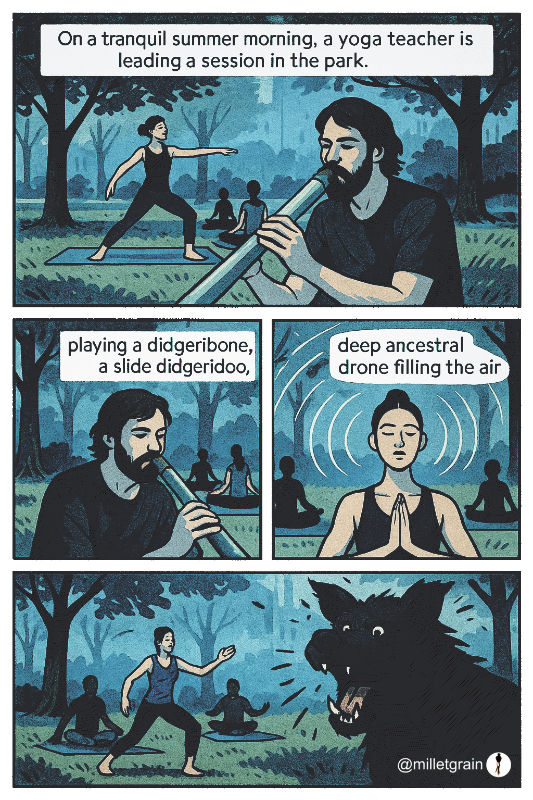
Of Breath and Bark: a morning yoga interlude in the park
But something lingered: a tone in the chest, a memory of breath stretched long and slow, a shared silence briefly held.
Sometimes it takes only a few notes to shift the air. And sometimes it takes a bark to remind you it was sacred all along.
In this performance I concentrated on a steadier pitch drone, without fully exploiting the sliding possibilities of the Didjeribone. Instead, the melodic soloing came from a ROLI Seaboard M , a compact five-dimensional MIDI controller whose soft Keywave surface allows notes to be pressed, bent, slid, and shaped with much more nuance than a conventional keyboard. Connected to an iPad running ROLI’s Seaboard app, it became a small but highly expressive sound engine for adding fluid melodic lines above the earthy drone of the Didjeribone.
Didgeridoo
I began playing the didgeridoo in 2008, when a friend of mine in Alice Springs told me he had one to sell. I still own that very first instrument. It was originally plain wood, until an Aboriginal artist named Bindi Day painted it for me in a dot-painting style, narrating a fascinating desert food story around its body.
That encounter happened in Central Australia, but it is important to say that the didgeridoo is not traditionally rooted there in the same way it is in the northern regions of Australia. By 2008, the instrument had already travelled widely as a national and global symbol, yet its deepest cultural lineages remain specific, local, and far older than the souvenir-market idea of “the didgeridoo” suggests.
Names, places, and cultural ground
“Didgeridoo” is a broad English-language name. In Northeast Arnhem Land, among Yolŋu people, the instrument is known as yiḏaki or, in some contexts, mandapul. In Western and North Central Arnhem Land, related traditional instruments are often called mago or mako. These are not merely alternate spellings for the same generic object: they point to particular places, song traditions, makers, custodians, playing styles, and cultural responsibilities.
Traditional yiḏaki and mago are commonly made from eucalyptus trunks or branches naturally hollowed by termites. A skilled maker selects the right tree, cuts and cleans the hollow, shapes the mouthpiece and bell, and tunes the instrument according to musical and cultural requirements. In many northern traditions, the instrument is inseparable from song, dance, kinship, ceremony, and Country. That cultural specificity is worth remembering whenever the instrument is brought into contemporary music, yoga, ambient performance, or electronic looping.
My own playing is therefore not an attempt to imitate ceremonial music. It belongs to a modern, personal, non-traditional musical context — a respectful distance that lets the instrument’s physics, breath, and meditative power speak without pretending to own the traditions from which it comes.
The physics: breath, tube, and body synthesizer
A useful way to understand the didgeridoo is to think of the performer and the instrument as one acoustic system. The didgeridoo-physik.de project describes this system almost like a body synthesizer: the lips excite the resonances of the air column, the voice can act as a second oscillator, the mouth and tongue behave like a dynamic filter, and the lungs and diaphragm provide a rhythmic engine.
The basic sound comes from vibrating the lips into a tube that is effectively closed at the mouth end and open at the bell. The tube’s internal shape determines its resonant frequencies. Unlike a perfectly regular theoretical pipe, a real didgeridoo is irregular: termite hollows, taper, bore changes, wall stiffness, and bell shape all influence the tone. The lowest playable resonance becomes the drone; higher resonances can be overblown as toots or horn-like accents.
The harmonics heard above the drone are not the same thing as the instrument’s own resonances. When a harmonic happens to fall near one of the tube’s resonant peaks, it is amplified and may appear as a bright “singing” overtone. When it falls between resonances, it is weaker or mostly perceived as part of the instrument’s colour. This is why two didgeridoos tuned to the same drone note can feel completely different under the lips.
Back pressure, circular breathing, and playability
Players often talk about back pressure: the feeling that the instrument pushes back and supports the lips. Technically, this is connected to acoustic impedance — the resistance/reactance felt at the mouthpiece as the player drives the air column. A well-balanced instrument gives enough feedback to help the drone remain stable without exhausting the player.
This feedback is one reason the instrument suits circular breathing so well. During circular breathing, the cheeks briefly store and push air outward while the player inhales through the nose. The goal is not brute force, but continuity: the drone keeps sounding while the breathing cycle disappears into the rhythm.
The didgeridoo may seem to play “one note,” but a skilled player can shape a surprising vocabulary: jaw drops and pressure bends, tongue pulses, diaphragm accents, vocal growls, sung notes, animal-like calls, percussive attacks, open and closed pressure pulses, and bright overtones created by changing the mouth cavity like a vowel filter. In this sense, the didgeridoo is less a fixed-pitch pipe than a living resonator controlled by breath, lips, throat, tongue, and body.
Didjeribone
The Didjeribone is the original slide didgeridoo invented by Australian player and innovator Charlie McMahon. It is made from two precisely fitted plastic tubes that slide inside one another, allowing the player to change the effective length of the instrument and therefore the pitch while playing.
Charlie’s own account traces the first Didjeribone back to 1981, when he wanted to expand the didgeridoo’s role in modern ensemble music. With his band Gondwanaland — and later Gondwana — the instrument was no longer only a supporting drone: it became a lead voice, interacting with synthesizers, percussion, bass, and broad outback atmospheres.
How the slide changes the music
On a normal didgeridoo, the fundamental drone is essentially fixed. You can bend it, colour it, and overblow it, but you cannot freely change key. The Didjeribone changes that. By sliding the inner tube, the player can move between marked pitches and melodic centres, making it much easier to play with loopers, tuned percussion, bass lines, keyboards, and modern harmonic structures.
The official Didjeribone design uses custom plastic tubing for a smooth, airtight slide. The closed position is marked as G, with further key marks descending through F# down to C, and an extended reach toward B and B♭. It also uses a rubber mouthpiece, a flared bell for a brighter and louder projection, permanent key markings, and a very light body — practical details that matter a lot when playing live.
That is exactly why the instrument fitted this park performance so well. I could keep the drone meditative, but still move the pitch enough to follow the harmonic mood of the looped percussion and ambient layers.
Charlie McMahon: outback, Gondwanaland, and invention
Charlie McMahon is one of the great mavericks of contemporary didgeridoo playing. His story is unusually vivid even before the music begins. As a teenager, he lost his right hand while experimenting with rockets. Later, he spent years in the Australian outback, developed a deep affinity with Aboriginal culture, and worked in the Department of Aboriginal Affairs, including work with Pintubi councils on water-bore projects that helped people return to parts of the Western Desert.
Musically, McMahon became known for pushing the didgeridoo into new territory. Gondwanaland fused didgeridoo with synthesizers and modern rhythmic textures at a time when that combination still felt radical. His work sits somewhere between ancient drone, electronic landscape, and Australian desert futurism. He has also recorded or performed in connection with film soundtracks and a wide range of artists, making him one of the key figures in moving the didgeridoo into contemporary, experimental, and amplified music.
His inventions are part of that same impulse. The Didjeribone gives the didgeridoo a movable pitch system. The Face Bass is another Charlie McMahon creation: often mistaken for a microphone, it is better understood as a separate electronic instrument/sensor system designed to capture and transform the intense low-frequency and vocal activity inside the player’s mouth. In the hands of Charlie and players such as Tjupurru, the Didjeribone and Face Bass become a hybrid acoustic-electronic performance system.
Charlie’s official Didjeribone shop is here: didjeribone.com/shop . The Face Bass page is here: didjeribone.com/facebass .
Learning the Didgeridoo
The best source I know in Italy for learning the didgeridoo properly is Andrea Ferroni, a renowned player, teacher, builder, and researcher based in the Turin area.
Ferroni was born in Turin in 1977 and discovered the didgeridoo in 2002, during a period when the instrument was exploding across European festivals and alternative music scenes. In 2004 he founded the Scuola del Didgeridoo in Turin with a clear pedagogical idea: to guide students from their very first sound all the way to the stage.
His teaching is not limited to “how to circular breathe.” Over the years, the school has covered beginner and advanced technique, rhythm, composition, repertoire, circular breathing, staccato sounds, toots, throat techniques, instrument building, acoustic design, and even CNC machining for didgeridoo construction. Ferroni is also known for applying acoustic and engineering knowledge to instrument design, including finite-element and resonance analysis from his professional background.
This is important because the didgeridoo is deceptively simple. A beginner sees a tube; a serious player discovers air pressure, embouchure, pulse, vowel shaping, phrasing, body mechanics, tuning, bore geometry, and respect for cultural context. A good teacher prevents the instrument from becoming a gimmick and turns it into a lifelong study of breath, rhythm, and sound.
Start from Andrea’s official site: andreaferroni.it . His didgeridoo and music page outlines lessons, workshops, instrument design, concerts, and custom building: Didgeridoo e musica . Historical notes on the Scuola del Didgeridoo are also available at Windproject .
Renowned Players — Listen to the Professionals
This is not a complete history, but a short listening map for anyone curious about how wide the didgeridoo and Didjeribone world can be.
- Djalu Gurruwiwi — A revered Galpu/Yolŋu yiḏaki master, maker, and cultural figure from Northeast Arnhem Land. Essential listening for anyone trying to understand yiḏaki beyond the generic “didgeridoo” label.
- David Blanasi — A legendary West Arnhem Land mago player and co-founder of the White Cockatoo Performing Group, often credited with bringing mago performance to international attention.
- William Barton — A leading contemporary Australian didgeridoo player and composer, widely recognised for bringing the instrument into orchestral, chamber, and contemporary classical contexts.
- Mark Atkins — A Yamatji musician, storyteller, painter, and didgeridoo maker whose collaborations have crossed rock, classical, and world-music boundaries.
- Charlie McMahon — Founder of Gondwanaland/Gondwana, inventor of the Didjeribone and Face Bass, and one of the most important experimental didgeridoo voices in modern Australian music.
- Tjupurru — A powerful Didjeribone and Face Bass performer whose live work pushes Charlie McMahon’s inventions into loop-based, rhythmic, amplified performance.
- Stephen Kent — A pioneering contemporary didgeridoo player associated with global fusion, ambient, and experimental music, especially through projects such as Trance Mission.
- Ganga Giri — A contemporary Australian performer known for combining yidaki/didgeridoo with drums, electronic production, dance grooves, and festival energy.
- Ash Dargan — A Larrakia musician and storyteller whose work connects didgeridoo performance with cultural education and contemporary recording.
- Si Mullumby — A contemporary player known for high-energy performance and for linking didgeridoo practice with breath, rhythm, and body awareness.
Further Reading and Sources
- Didgeridoo Physics — Sound Design and Crafting — detailed acoustic notes on resonances, impedance, overblows, vocal tract filtering, and instrument design.
- Acoustics of the yidaki or didjeridu — UNSW — accessible research notes on circular breathing, vocalisation, and the player/instrument system.
- YiḏakiStory.com — resources on yiḏaki and Yolŋu culture developed with Yolŋu people from Northeast Arnhem Land.
- Didjeribone — official shop — Charlie McMahon’s slide didgeridoo, accessories, and music.
- Didjeribone Design Process — official notes on the instrument’s development, materials, tuning marks, and construction.
- Charlie McMahon — Didjeribone — official overview of McMahon’s musical background and collaborations.
- Face Bass — Didjeribone — official notes on Charlie McMahon’s Face Bass system.
- Andrea Ferroni — official site for Andrea Ferroni’s music, teaching, research, and didgeridoo work.
- Andrea Ferroni on didgeridoo-physik.de — profile of Ferroni as performer, maker, and acoustic researcher.
- Scuola del Didgeridoo — Windproject — historical notes on Ferroni’s school in the Turin area.
- William Barton — official biography — composer, multi-instrumentalist, vocalist, and leading didgeridoo player.
- Mark Atkins — official site — didgeridoo maker, painter, composer, and performer.
- Stephen Kent — official site — contemporary didgeridoo performer and teacher.
- Ganga Giri — official site — contemporary didgeridoo/yidaki and beats performer.
- Tjupurru — Didjeribone — Didjeribone and Face Bass performer profile.