Citysink – Berlin, Underdogs & Catacombs
The Trilogy of the Nomads
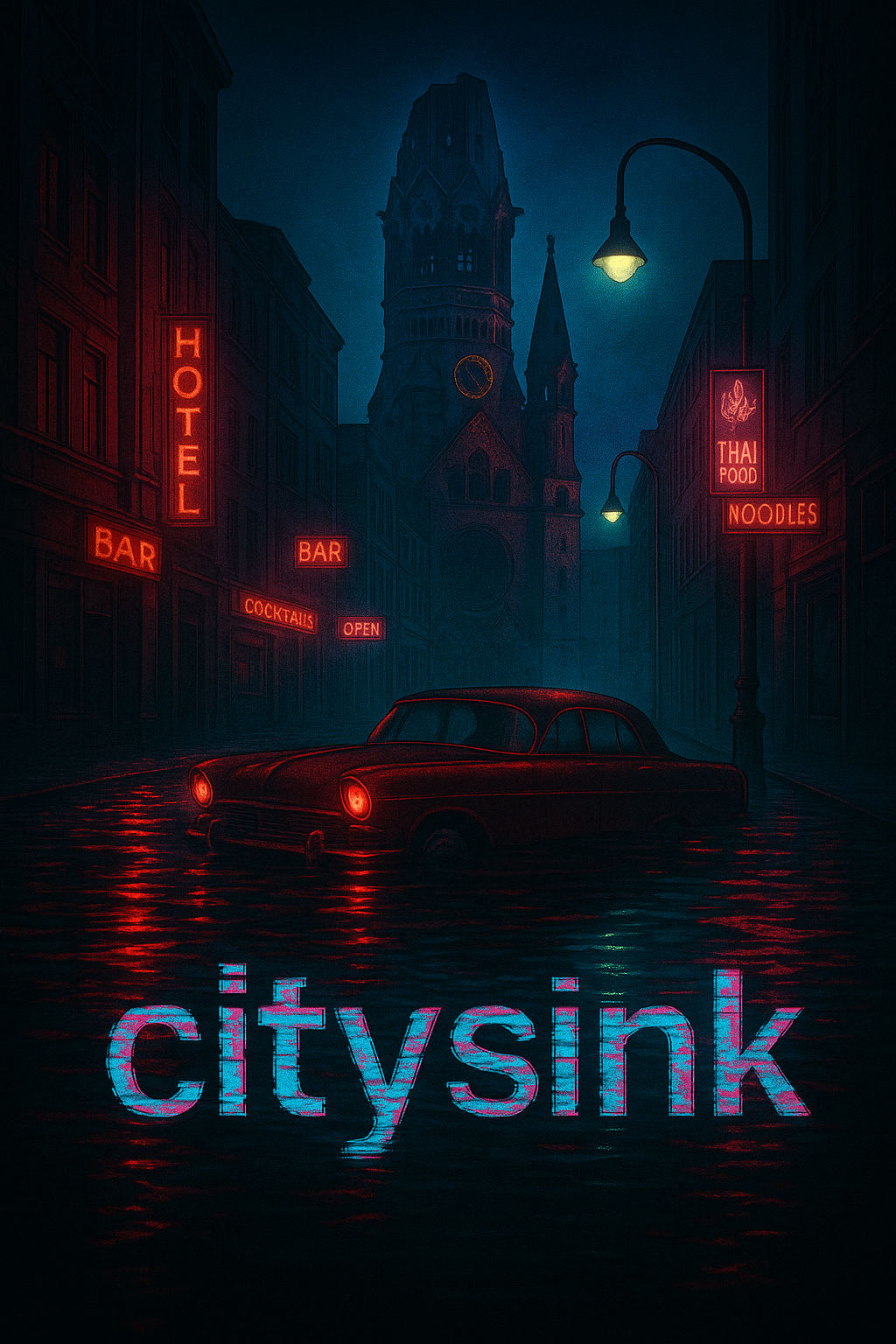
What if your everyday commute through Berlin did not simply end at the office, but at the absolute edge of time itself?
🌆 Citysink is a surreal Berlin cyber-noir trip in which a brilliant inventor leaves his retro-tech high-rise workspace on an azure bicycle, witnesses an impossible reality glitch at a currywurst kiosk, and is pulled into a paranoid underworld of surveillance, bureaucracy, wild animals, analog machines, and metaphysical decay.
Hunted by a mysterious Thai mob boss in red leather and her strangely uniformed lackeys, temporarily saved by roaming wild boars, and guided by a cryptic ant-summoning wanderer, the inventor descends beneath the city into a sand-filled labyrinth of abandoned electronics. There, he confronts every age of his own life and realizes that his escape may already have happened infinitely many times.
As machinery, memory, and nature collapse into one another, the journey builds toward a rapid-aging finale: an elevator door opens not to a cubicle, but to a morning shore where Berlin itself has been rewritten.
Ready to dive into the sinkhole? 🚲⚡🌀
Behind the Scenes of Citysink: Developing a Surreal Berlin Cyber-Noir
When crafting the visual language for a music video, the architecture of the track often dictates the architecture of the film. The title Citysink immediately suggested layers of disappearance: drains, basements, sewerage, cellars, underground stations, and all those hidden systems that keep a city alive while quietly absorbing its debris.
Berlin became the ideal psychological machine for that idea. It is modern and scarred, elegant and improvised, full of glass towers, stations, abandoned-looking corners, punk memories, and urban wildlife. The story moves through this tension: from the marble surfaces of a high-rise office to the night streets of Charlottenburg, from a currywurst kiosk to a squat-like refuge, from a vintage electronics shop to the catacomb-like basement where the city finally swallows the protagonist whole.
The result is a small spy drama with a surreal-philosophical sci-fi shore: deadpan absurdity, existential melancholy, retro analog technology, and a Berlin mood somewhere between Wim Wenders, Kafka, cyberpunk noir, and a fever dream generated by a malfunctioning machine.
The Cinematic Visual Sequence: The Full Plot
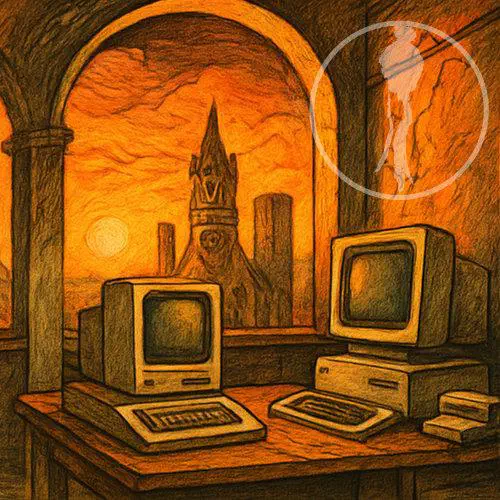
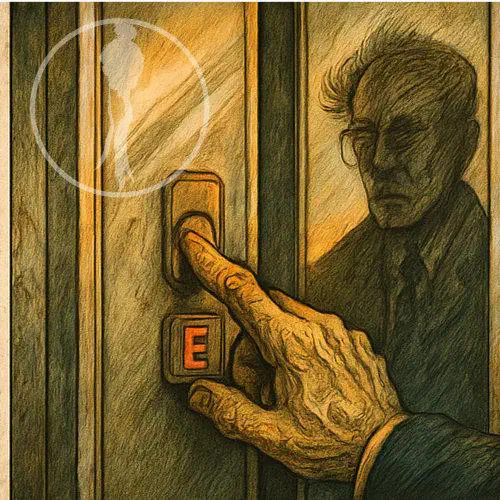
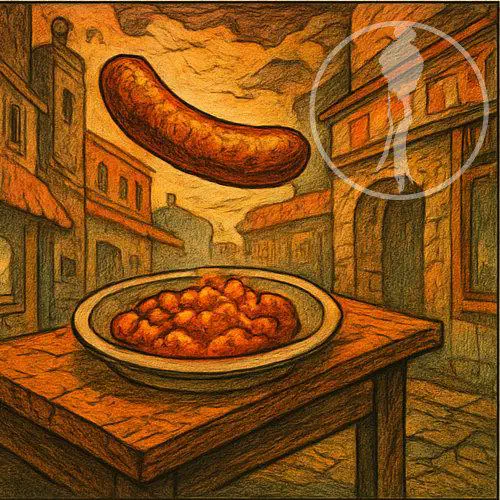

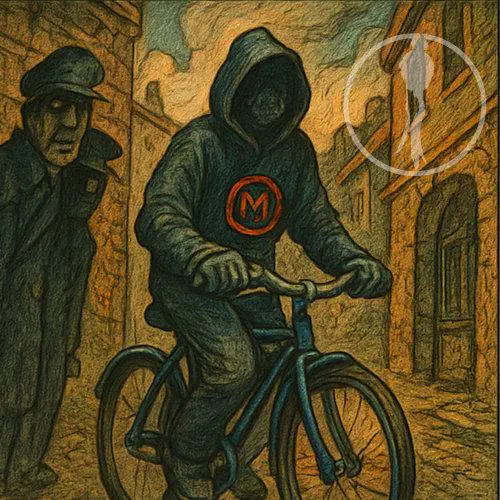
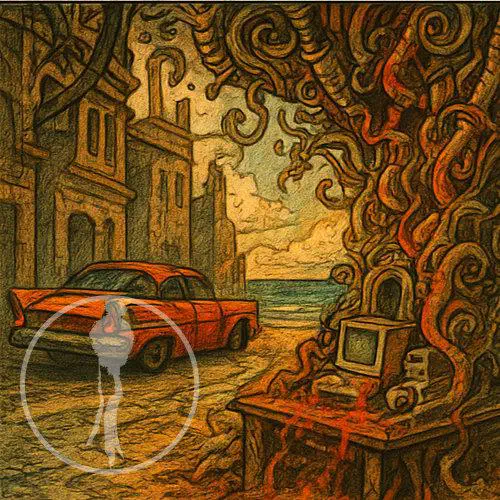
the storyboard as originally planned.
🔸 Act I: Dusk, Routine, and the First Glitch
At sunset, the inventor works alone in a spacious top-floor office inside Berlin’s Europa Center. Marble surfaces, heavy wooden furniture, vintage Apple II and early Macintosh computers, and humming dot-matrix printers define a retro-technological world. Beyond the glass walls, the Kaiser-Wilhelm-Gedächtniskirche anchors Breitscheidplatz in warm golden light.
He takes the elevator to the ground floor, walks out with his signature azure bicycle, and crosses the square through autumn leaves. At a currywurst kiosk, an absurd reality glitch breaks the ordinary flow of the evening: a piece of sausage jumps toward another customer’s mouth, as if the city has skipped a frame.
The inventor freezes. Nearby, a vintage red 1958 Plymouth Fury idles in traffic. A Thai woman in sharp red leather watches him with two uniformed lackeys in black jackets, tram-driver hats, and bleached blue-and-white jeans. Back in the empty office, handmade wooden consoles switch themselves on, overheat, and change their LEDs from green to warning red.
🔸 Act II: Nightfall, Refuge, and the Descent
The inventor flees by bicycle into the blue hour, pursued through a city where wild boars roam after dark. Their sudden appearance interrupts the gang’s first attempt to seize him, turning the chase into a moment of deadpan animal chaos.
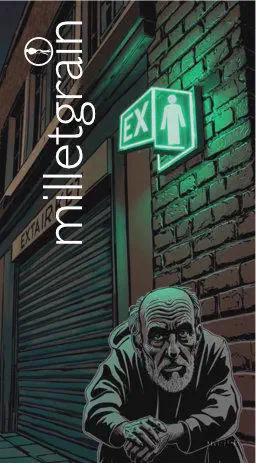
He reaches O’Rags Kollektiv, a warm, grimy, graffiti-covered refuge inspired by the memory of Berlin’s squat and art-house culture, especially the old spirit of Kunsthaus Tacheles. There, under a dangling bulb, an elderly homeless wanderer — the Penner — warns him to take a train, catch a plane, and leave the country before he “ages like air through a bottle’s neck.” As he speaks, ants begin pouring from a crack in the wall.
The escape fails. The gang captures the inventor on the train and brings him to a vintage electronics shop near Breitscheidplatz. The boss demands he sign away his reality-altering patents under a ridiculous disclosure agreement stamped with the Pfandflasche logo. When he refuses, he is thrown into the shop’s basement: a sand-and-brick maze of cables, bulbs, obsolete devices, and circular time.
Inside the citysink, he meets versions of himself from childhood to extreme old age. The loop becomes clear: this descent has happened before, perhaps forever. Then the Penner returns with the ants. The swarm consumes the gang, leaving only terrified eyes, scattered traces, and a single high-heeled shoe covered in black movement.
🔸 Act III: Dawn, Return, and Transformation
The inventor escapes into the cold pre-dawn streets, only to discover that his bicycle has been stolen. Exhausted, he walks past street cleaners and the waking city toward Zoologischer Garten Bahnhof, trying to return to the office as if routine could still rescue him.
But time has already broken. With every step back toward the Europa Center, he ages rapidly. By the time he reaches the elevator, he is an old man.
The doors open onto the final impossibility: the office has vanished and become a serene sandy shore. Real waves roll through the space. The ceiling has opened into sails and blue morning sky. As sand flows through his fingers, the distant Berlin skyline appears beyond the beach, while colored, glowing pebbles pulse across the shore like fragments of his machines now embedded in nature itself.
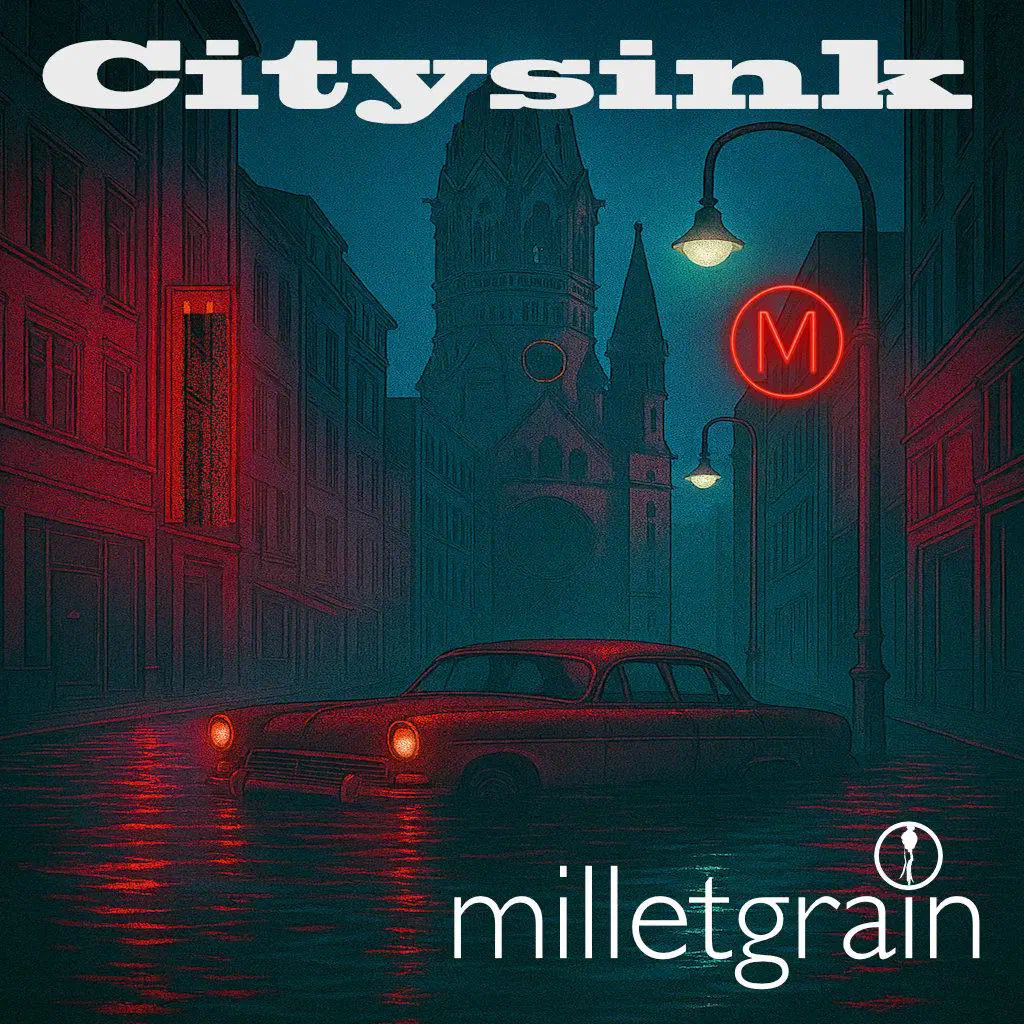
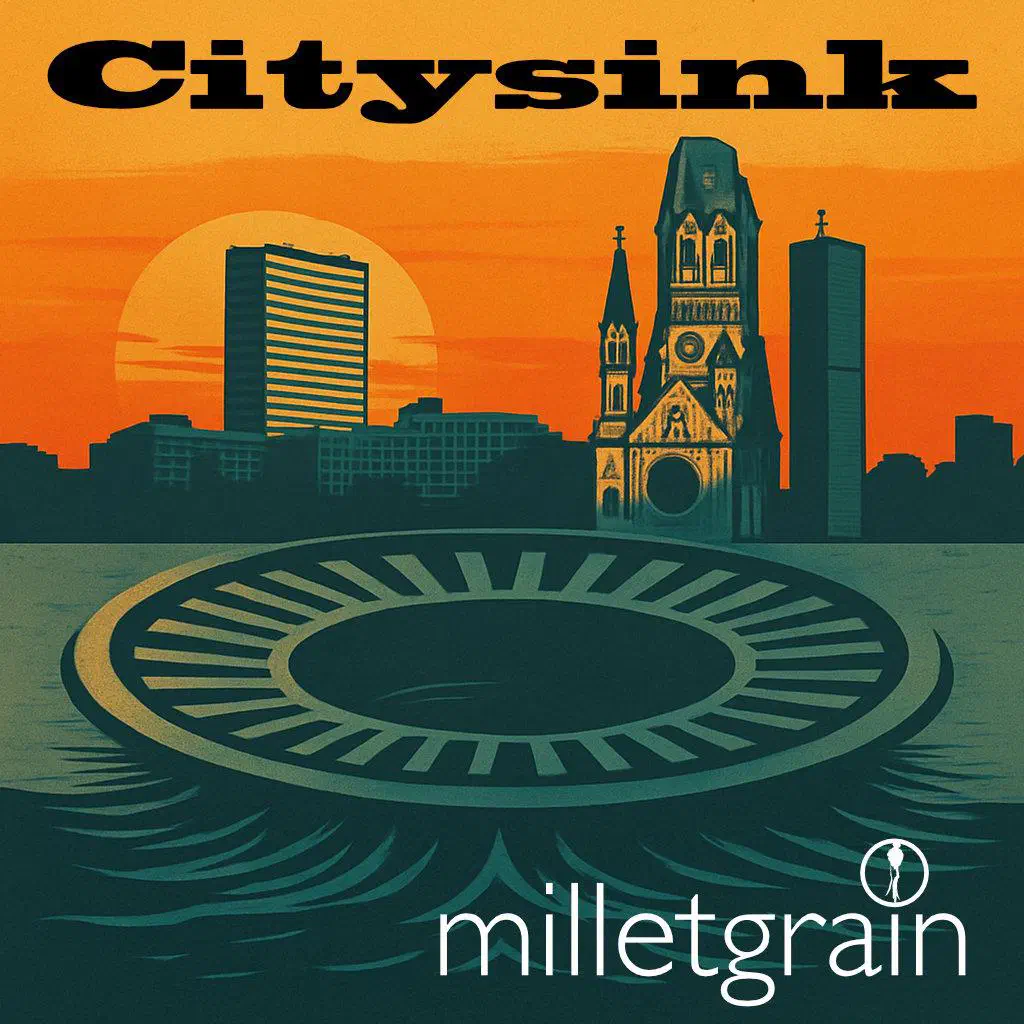
🎥 Guided Reading: Alessandra Arcieri on the Cinematic DNA of Citysink
During the development of the project, Alessandra Arcieri — writer, director, performer, and a careful explorer of storytelling across literature, theatre, cinema, and visual narration — helped me recognise a number of cinematic and literary echoes that were already present in the material, even when I was not fully aware of them.
My own references were more immediate and personal: Kafka’s absurd authority, Terry Gilliam’s Brazil, John Carpenter’s Christine, the pulse of Run Lola Run, and the memory of Berlin places I actually knew, such as Tacheles and the post-reunification alternative scene. Alessandra, with her broader knowledge of cinema and dramaturgy, pointed out deeper resonances: the urban melancholy of Wim Wenders, the identity fractures of contemporary sci-fi, the German obsession with time loops, and the deadpan surrealism of more recent television.
Berlin as a Spiritual and Psychological Landscape
Alessandra Arcieri: Looking at Citysink, one connection that immediately comes to mind is not necessarily one you needed to start from consciously: Wim Wenders. In Wings of Desire, Berlin is not just a city, but a spiritual weather system — a place of watchers, invisible presences, solitude, memory, and thresholds. Your Berlin has a different tone, darker and more absurd, but it also behaves as an inner landscape.
Milletgrain: That makes sense, even if Wenders was not one of my conscious starting points. I was thinking more about the Berlin I had actually experienced: the elevated streets, the strange corners around Zoologischer Garten, the feeling of old West Berlin still echoing under the commercial surface. But I can recognise the connection. In Citysink, Berlin is not background scenery. It reacts, watches, sinks, and finally mutates.
Alessandra’s reading helped clarify one of the most important aspects of the video: the city is not merely the place where the story happens. It is the mechanism that transforms the protagonist. The Europa Center, Breitscheidplatz, the Kaiser-Wilhelm-Gedächtniskirche, the streets, the train, the basements and the impossible beach are all stages of the same internal collapse. Berlin becomes a psychic map.
The inventor begins in a high-rise office, surrounded by vintage machines and rational control. By the end, the same office has become a shore. The journey is vertical as much as narrative: from the top floor to the street, from the street to the underground, from the underground to a metaphysical coastline.
Kafka, Paperwork, and the Absurdity of Authority
Alessandra Arcieri: Kafka is one of the references you do know directly, and it is probably the most structural one. The protagonist is an inventor, therefore a man of logic, calculation and design. But he is suddenly trapped inside a system where logic still exists, only in a corrupted form. That is very Kafkaesque.
Milletgrain: Yes, Kafka was definitely there. I liked the idea of a rational person being cornered by something absurd, not necessarily because it is supernatural, but because it behaves like a system with rules he cannot access.
The levitating currywurst is the first rupture. It is ridiculous, almost slapstick, but it also announces that reality has begun to obey another grammar. The protagonist’s reaction is not heroic; he simply freezes. That frozen moment is essential: the world has glitched, and he has seen too much.
The later demand to sign a disclosure agreement pushes the same absurdity into bureaucratic territory. The document is threatening, but also stupidly mundane. The “Pfandflasche” logo turns the entire scene into an administrative nightmare: reality-altering patents, criminal pressure, a deposit-bottle brewery, and a mob boss behaving like a corporate officer. Kafka’s world often feels terrifying because authority does not need to explain itself. In Citysink, that authority wears red leather, drives a Plymouth Fury, and still wants paperwork.
Terry Gilliam, Retro Machinery, and the Comedy of Systems
Alessandra Arcieri: Your reference to Terry Gilliam’s Brazil is very revealing. In Brazil, bureaucracy is not clean or abstract. It is made of ducts, forms, screens, broken machines, cables, offices and oppressive interiors. Citysink has a similar love for retro-futuristic clutter.
Milletgrain: Absolutely. I have always been fascinated by that kind of machinery: old computers, analogue devices, strange consoles, things that look handmade and powerful but also unstable. In Citysink, the technology is never sleek. It is dusty, wooden, improvised, overheating.
The office is not a futuristic laboratory. It is closer to a memory of computing: Apple II machines, early Macintosh computers, dot-matrix printers, handmade consoles with joystick knobs, blinking LEDs. This gives the science-fiction element a physical weight. The machines feel as if they belong to the past, yet they are capable of damaging the present.
This is where Brazil becomes a useful coordinate. The absurdity is not only in the plot, but in the texture of the world. Technology does not liberate the protagonist. It traps him inside a system of wires, documents, basements and malfunctioning devices.
Christine, the Plymouth Fury, and Haunted Americana in Berlin
Alessandra Arcieri: The red 1958 Plymouth Fury introduces another kind of memory: American genre cinema. Since you mentioned John Carpenter’s Christine, the car immediately stops being just a vehicle. It becomes a presence.
Milletgrain: Yes, that was deliberate. The Plymouth Fury is not a neutral prop. It carries that haunted, slightly demonic aura. Even before anything happens, the car already feels like trouble.
In Christine, the car is an object possessed by desire, violence and obsession. In Citysink, the red Plymouth does not need to be literally supernatural. Its function is symbolic: it follows, waits, frames the gang, and gives the chase a strange cinematic excess. It brings a piece of American horror mythology into West Berlin’s urban landscape.
That contrast is important. The car looks too theatrical for the setting, almost as if a different movie has driven into the frame. This strengthens the sense that Citysink is made of overlapping cinematic layers: Berlin realism, Kafkaesque paranoia, retro sci-fi, American cult cinema, and surreal fable.
Run Lola Run and the Velocity of Berlin
Alessandra Arcieri: Another reference you actually recognised is Run Lola Run. That film is not only about running through Berlin; it is about time, rhythm, repetition, and the possibility that one small variation can change everything.
Milletgrain: Yes. I was not trying to quote it directly, but the idea of Berlin as a kinetic maze is definitely close. The bicycle, the chase, the train, the repeated return to the office — all of that has a rhythmic quality.
Citysink is slower and more nocturnal than Run Lola Run, but it shares an obsession with movement through the city. The protagonist crosses Berlin as if trying to outrun a pattern that has already been written. His bicycle is almost comic in contrast with the Plymouth Fury, but it also makes him vulnerable and human.
The chase is not just action. It is musical structure. The city becomes a score: streets, stations, elevators, basements and corridors are edited like rhythmic passages. The protagonist keeps moving, but every movement brings him closer to the loop.
Tacheles, Squats, and the Protection of the Margins
Alessandra Arcieri: The O’Rags Kollektiv sequence is very important because it briefly changes the social temperature of the story. Until then, the protagonist is isolated. The squat gives him refuge, even if only temporarily. This is where your real memory of Tacheles and Berlin’s alternative spaces enters the video most clearly.
Milletgrain: That part is personal. I frequented Tacheles and places that carried that kind of energy. I wanted O’Rags to feel chaotic, dirty, artistic, precarious, but also warm. A place outside the official city.
The squat is the opposite of the office. The office is rational, vertical, private, and technologically controlled. O’Rags is horizontal, collective, improvised, full of graffiti, broken surfaces and human residue. It is not safe in a conventional sense, but it is alive.
Alessandra pointed out that this gives the story a recurring archetype: the hunted visionary protected, briefly, by outsiders. This connects Citysink to many contemporary narratives where marginal communities — artists, squatters, hackers, drop-outs, drifters — become the only people able to recognise danger before the official world does.
The Penner as Prophet, Trickster, and Threshold Figure
Alessandra Arcieri: The homeless elder — the Penner — is not only a side character. He works like a threshold figure. He is socially invisible, yet he understands the metaphysical situation better than anyone else.
Milletgrain: Exactly. He is not presented as respectable or wise in a polished way. He is broken, drunk-looking, almost ridiculous. But he sees something. He knows the protagonist is in danger before the protagonist understands it himself.
The elder belongs to a long tradition of prophetic outsiders: figures who stand at the edge of society and speak in riddles. His warning — to take a train, catch a plane, and leave before the protagonist “ages like air through a bottle’s neck” — sounds absurd, but later becomes painfully accurate.
The ants complete his mythic function. They first appear as something small and almost ignorable, emerging from a crack in the wall. Later they become a force of judgment, pouring through the underground and destroying the gang. Alessandra read them as the revenge of the neglected: the tiny, the collective, the subterranean. In a story obsessed with sinking, the smallest creatures of the underground become the only army capable of changing the outcome.
German Time-Loop Anxiety: Dark, Tunnels, and Multiple Selves
Alessandra Arcieri: One reference you were not necessarily starting from is Dark, but the resemblance is strong. German settings, tunnels, old technology, inherited loops, and characters confronting versions of themselves across time — these are all part of its vocabulary.
Milletgrain: I knew very little about Dark, but when you pointed it out, I could see why it applies. The tunnel sequence in Citysink is definitely about time becoming physical.
The basement is not just a prison. It is the “sink” of the title made visible: a place where cables, sand, old electronics, memory and identity accumulate. When the inventor sees himself as a child, an adult and an old man, the story stops being only a chase and becomes a temporal trap.
Alessandra’s reading connects this to a specifically German strain of metaphysical science fiction: tunnels as wounds in time, old machinery as a gateway to repetition, and family or identity as something circular rather than linear. In Citysink, the protagonist does not simply remember his life. He sees it compressed into the architecture around him.
Wachowski-Style Identity Collapse and Sense8
Alessandra Arcieri: I also see a Wachowski resonance, especially with Sense8, though the tone is very different. Sense8 is expansive, emotional and global, while Citysink is more claustrophobic and nocturnal. But both are interested in porous identity.
Milletgrain: That was not conscious for me, but I like the idea. The protagonist is not only being chased physically. His identity starts leaking.
In Sense8, people appear in each other’s spaces, sharing perception across distance. In Citysink, the inventor’s machines react to events happening elsewhere, the city seems to know what he has seen, and the basement confronts him with multiple versions of himself. The boundary between mind, city, technology and fate becomes unstable.
The connection is not about plot similarity, but about permeability. The self is no longer sealed. Rooms open into other realities. Bodies carry other times. A technological invention becomes a metaphysical infection.
Contemporary Deadpan Surrealism: Atlanta, Legion, The Leftovers, and Severance
Alessandra Arcieri: Several newer references help describe the tone, even if they were not part of your conscious toolbox. Atlanta, Legion, The Leftovers, and even Severance all show different ways of making the surreal feel ordinary.
Milletgrain: That is useful, because the currywurst glitch should not feel like a big fantasy effect. It should feel wrong, but almost casually wrong.
This is where contemporary television becomes a helpful lens. Atlanta often lets absurd events happen without overexplaining them. Legion turns unstable perception into visual language. The Leftovers treats unexplained phenomena as emotional facts rather than puzzles to solve. Severance transforms office space into a psychological and bureaucratic labyrinth.
Citysink touches all these territories without belonging fully to any of them. The office is not only a workplace. It is a mind-space. The gang is not only criminal. It is systemic pressure. The currywurst is not only a joke. It is the first visible crack. The beach is not only surreal. It is the final breach between interior and exterior reality.
Tales from the Loop and Lo-Fi Science Fiction
Alessandra Arcieri: Another useful comparison is Tales from the Loop, especially for the emotional treatment of old technology. There, machines are mysterious without being glossy. They feel heavy, quiet, almost melancholic.
Milletgrain: That is very close to what I like. I am much more attracted to analogue imperfection than to clean science fiction. I like devices that feel invented in a garage, or recovered from a forgotten lab.
The consoles in Citysink work in that direction. They are handmade, tactile, almost childish with their red and green joystick knobs, yet they are connected to enormous consequences. Their overheating is both technical and symbolic. They are not simply malfunctioning; they are reacting to reality itself.
This gives the science-fiction element a lo-fi melancholy. The future has not arrived as something shiny. It has arrived through obsolete machines, abandoned electronics, basements, wires and sand.
Animals as Glitches in the Urban Order
Alessandra Arcieri: The animals are crucial: wild pigs and ants. They are not decorative. They interrupt systems. The pigs break the chase; the ants destroy the gang. Nature appears first as absurdity, then as judgment.
Milletgrain: I liked the idea that the protagonist is saved by something completely ridiculous. The wild pigs are funny, but they also belong to Berlin. They make the city feel alive in a way that bureaucracy and technology cannot control.
The pigs introduce comic disorder at street level. The ants introduce collective force underground. Together, they create a counter-system to the gang, the paperwork, the machines and the chase. They are not sentimental symbols of nature. They are disruptive, dirty, inconvenient, and finally decisive.
In this sense, Citysink does not oppose nature and technology in a simple way. It lets them contaminate each other. By the end, glowing artificial pebbles lie on the beach as if technological debris has become part of the natural world.
The Beach Inside the Office
Alessandra Arcieri: After all this downward movement — basements, tunnels, paperwork, capture, paranoia — the final image reverses the direction. The office does not collapse further into the underground. It opens into a beach. That feels less like an escape than a transformation.
Milletgrain: Because the title is Citysink. Everything has been falling downward — into drains, basements, systems, paperwork, paranoia. The beach is the reversal: the underground becomes a shore, the office becomes an opening, and the artificial pebbles become part of nature. It is not exactly salvation. It is more like reality accepting the damage and growing around it.
The ending does not erase the nightmare. It metabolises it. The inventor has aged, the loop has marked him, and the city has not returned to normal. Instead, the architecture of his former life has opened into something impossible.
The beach is peaceful, but not innocent. It contains the residue of the machines, the sand of the tunnels, the time that has passed through the protagonist’s body, and the strange beauty of a damaged reality reorganising itself.
A Working Formula
Alessandra Arcieri: So perhaps Citysink is not a direct homage to one specific film, but a collision of atmospheres: Berlin poetry, bureaucratic nightmare, retro-futuristic machinery, time-loop anxiety, urban chase, haunted Americana, and contemporary surrealism.
Milletgrain: Citysink is Wenders’ Berlin poetry dragged through Kafka’s paperwork, Gilliam’s retro-bureaucratic machinery, Wachowski-style identity collapse, German time-loop anxiety, and contemporary deadpan surrealism — then washed ashore inside an office at sunrise.
That formula may sound excessive, but it captures the nature of the project. Citysink was not built as a clean genre exercise. It is a layered visual fable: part Berlin memory, part cyber-noir, part absurdist chase, part metaphysical science fiction.
Alessandra Arcieri: That sounds like a beautifully complex puzzle, but also a very personal city fable.
Milletgrain: That is the hope. It should work as a strange little narrative on the surface — inventor, bicycle, mob, pigs, ants, basement, beach — but underneath it is about aging, losing control, and realizing that the systems we build may eventually dream us back.
Some references were conscious from the beginning. Others were recognised only later, through your reading, Alessandra. That distinction matters. The value of the guided reading is not to prove that every image was planned as a quotation, but to show how images, once assembled, begin to reveal their own ancestry.