Proiezione Origami — Book Cover Design
Condensing a cyberzen novel into one folded, electric image
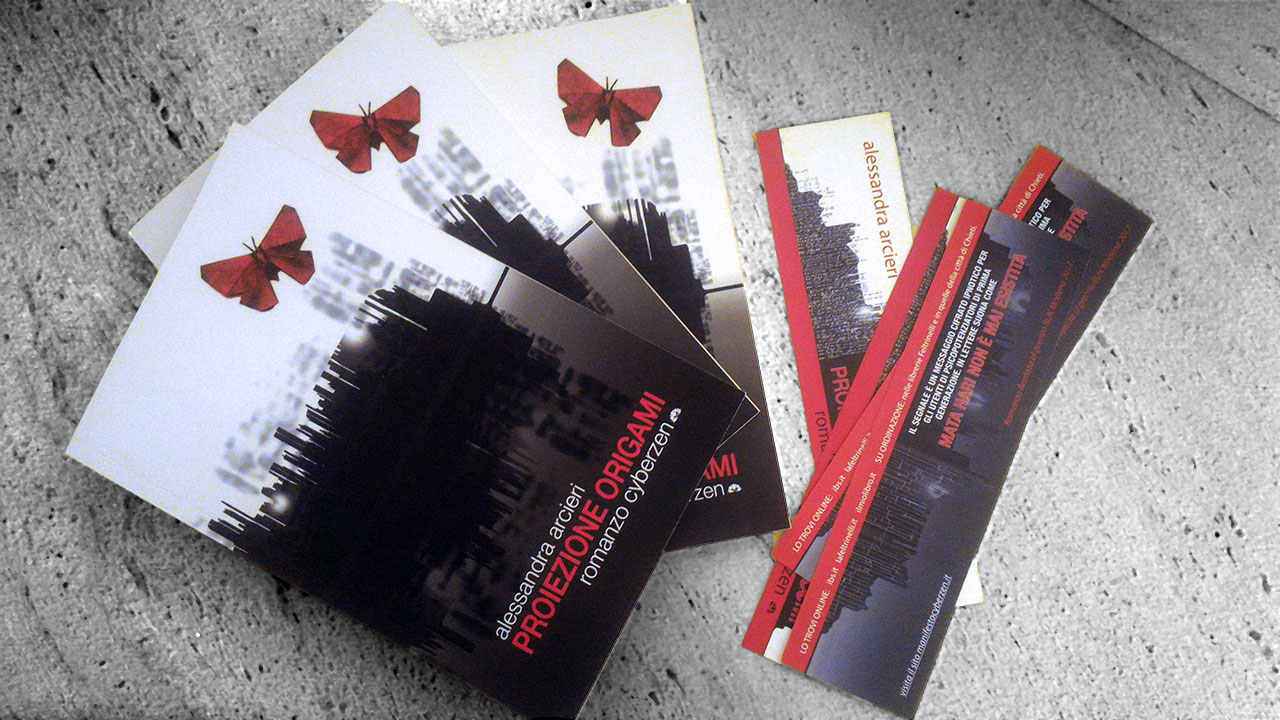
This cover design project began as a collaboration with the Italian author, screenwriter and director Alessandra Arcieri, for her cryptic futuristic novel Proiezione Origami. The book was published in 2015 by ilmiolibro self publishing and described as a romanzo cyberzen: a cyberpunk-leaning, dystopian story in which consciousness, code, combat, role-playing logic and spiritual circuitry blur into one unfolding stream.
“Rome, New York, Bombay. What will be the next target?”
Set in a fragmented future, the narrative moves through transcontinental power plays, high-stakes psycho-games and mythic figures recast inside digital landscapes. Its protagonist, Agent Alpha, must decode a layered conspiracy built by a corporate demiurge. Her mission is hidden inside Walt Whitman’s I Sing the Body Electric — not simply as a literary reference, but as a kind of hacked anthem for the electrified self.
Alessandra Arcieri and the Cyberzen Thread
Alessandra Arcieri’s career naturally sits between writing, cinema, teaching and hybrid media. Her public profiles describe her as a member of Writers Guild Italia, a screenwriter, author and director whose work spans television, documentaries, video clips, creative writing and screenwriting education. Her biography also connects her to projects for SKY, Discovery Real Time and Rai 4, short films on social and health-related themes, and later documentary work such as Il Teatro del Silenzio and La Mia Vita con Osho – Racconti da Ustica.
What makes Proiezione Origami particularly coherent with her wider path is the Cyberzen idea itself. In 2015, Arcieri presented the Manifesto Cyberzen, framing it as an “oriental wisdom oriented” branch of cyberpunk. The novel later became a finalist at BUK Modena 2017, a detail that confirms the book’s life beyond the original self-publishing context.
That mixture — technological dystopia, spiritual tension, game structures, altered embodiment and cinematic pacing — became the conceptual soil for the cover.
Design Requirements
The author had a very clear visual direction from the beginning. The cover had to include:
- an urban skyline as a backdrop;
- mathematical formulas flowing through the composition;
- the sentence “Mata-Hari non è mai esistita – Mata-Hari has never existed” displayed prominently;
- a strong sense of duality: plus/minus, presence/absence, light/shadow, body/signal, sky/reflection.
The challenge was to make these ingredients feel like one coded system rather than a collage of cyberpunk symbols.
From Voice to Skyline
The first versions started from a more conventional static cityscape. The breakthrough came from sound.
Instead of drawing buildings directly, I recorded and visualized the spoken phrase “Mata-Hari has never existed”, capturing its waveform with all the small accents, pauses and stresses of a real human voice. That waveform became the skyline. In one move, the city stopped being just a backdrop and became a trace of language: analog speech translated into electric shape.
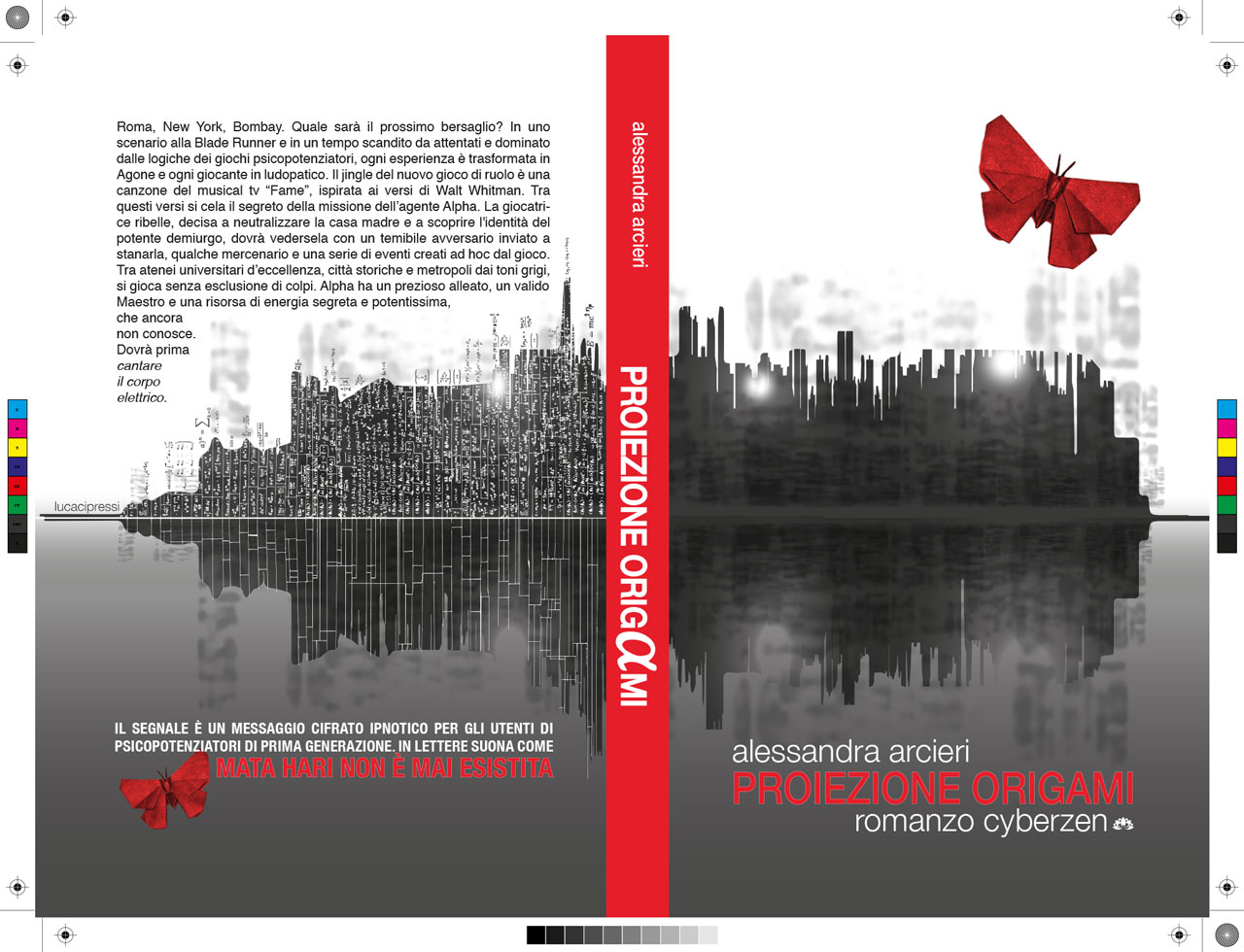
The full wraparound cover. The skyline is formed from the spoken soundwave of the phrase ‘Mata-Hari has never existed’.
This decision allowed the design to bridge several of the novel’s core oppositions: voice and code, body and signal, human breath and machine reading. It also gave the cover a hidden layer: the viewer sees a city, but the book quietly knows it is also a sentence.
Formulas, Antennas and a Cleaner Front Cover
The mathematical formulas were repositioned so that they climbed upward from the rear cover like antennas, transmission towers or stray thoughts leaving the page. Keeping most of this visual noise on the back allowed the front cover to remain cleaner, darker and more monolithic — closer to the mask of a cipher than to a typical illustrated scene.
The skyline then becomes a threshold. Above it, the sky. Below it, the reflected lake. The soundwave belongs to both realms at once, hinting at inversion, mirroring and recursion: a visual echo of a story that reshapes itself layer by layer.
Cyberpunk Symbolism and Whitman’s Verse
The book draws from Walt Whitman’s I Sing the Body Electric, a poem that turns the body into something sacred, social and radiant. In Proiezione Origami, that energy is repurposed as a hacked manifesto: the electric body becomes both the message and the medium through which the game can be understood.
“If the body were not the soul, what is the soul?”
The mirrored lower waveform on the cover responds to that line visually. It is both reflection and echo, a second body beneath the first. The city sings itself digitally, electrically, almost as if the whole urban system were a nervous system waiting to be decoded.
Origami as Metaphor
To anchor the cover to the title, I designed a minimalist origami butterfly: fragile, geometric, transformative and deliberately artificial. It appears on the back cover like a small totem of folded logic.
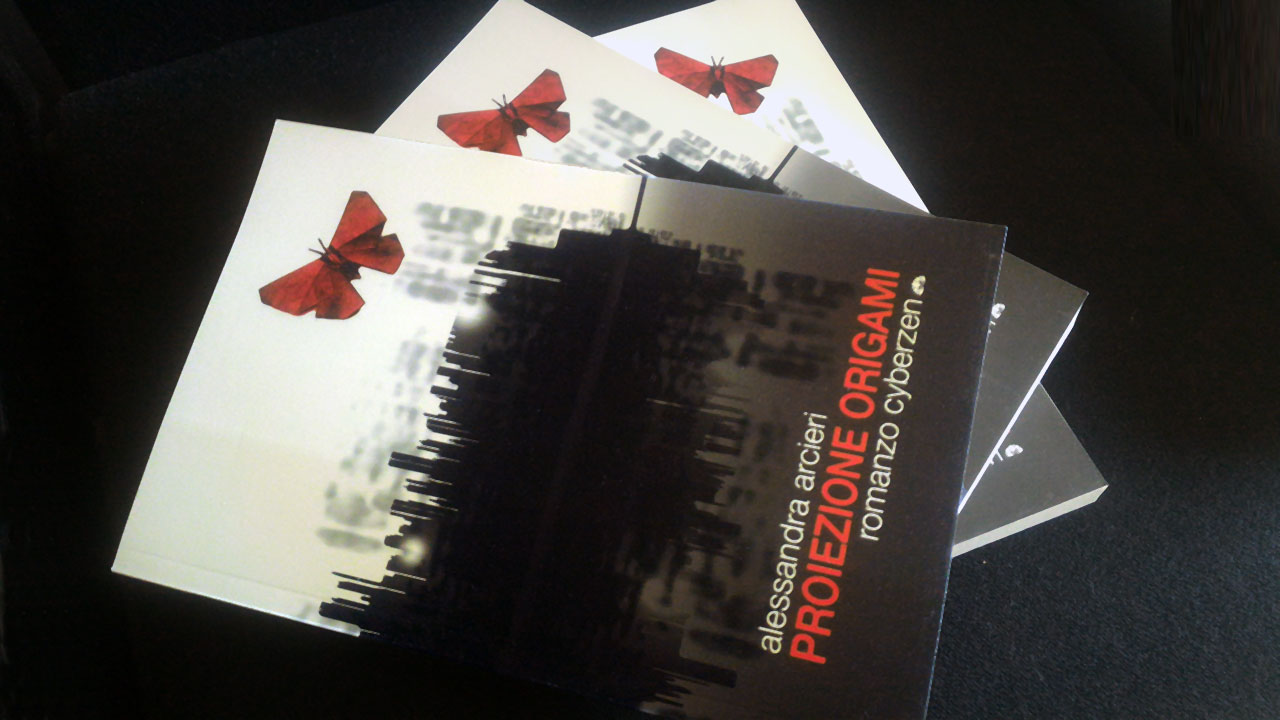
Origami is folded language. It begins as a flat surface, then becomes structure through hidden rules, pressure, symmetry and reversal. That made it a perfect metaphor for a plot that changes shape every time another layer is opened.
My Preface — Cyberpunk in Tone
The story interlaces seamlessly between the ever-existing layers of knowledge and notion, human and machine, duality (0, 1), pivoting over the fulcrum of the third state: nil, Z, or the high impedance mode.
Just like ideal operational amplifiers, the travelling Agents with infinite input impedance and zero output impedance will induce stray currents in your body electric — across a live circuit board shaped just like a table game.
– LC
Final Notes
The final cover was printed as a full wraparound layout with high-gloss lamination. The title sits between two realms: solid and wave, text and voice, skyline and reflection. Like the book itself, the image asks the reader to listen as much as to look.
I still like that the central design trick is almost invisible at first glance. A city made of speech. A skyline that is also a password. A cyberzen novel folded into a single electric surface.
Purchase
You can find Proiezione Origami by Alessandra Arcieri at: