Campari Dreaming — Honey Ants Jam Session Night
Central Australian Dreaming in Central Italy
It all began during a casual evening at Bar dello Sport in Serramonacesca , with friends, locals, and the unmistakable red glow of Campari Soda bottles on the tables. The bar had that warm, informal energy that small Abruzzo villages can suddenly produce at night: half conversation, half improvisation, and always the feeling that something could be decided over the next round.
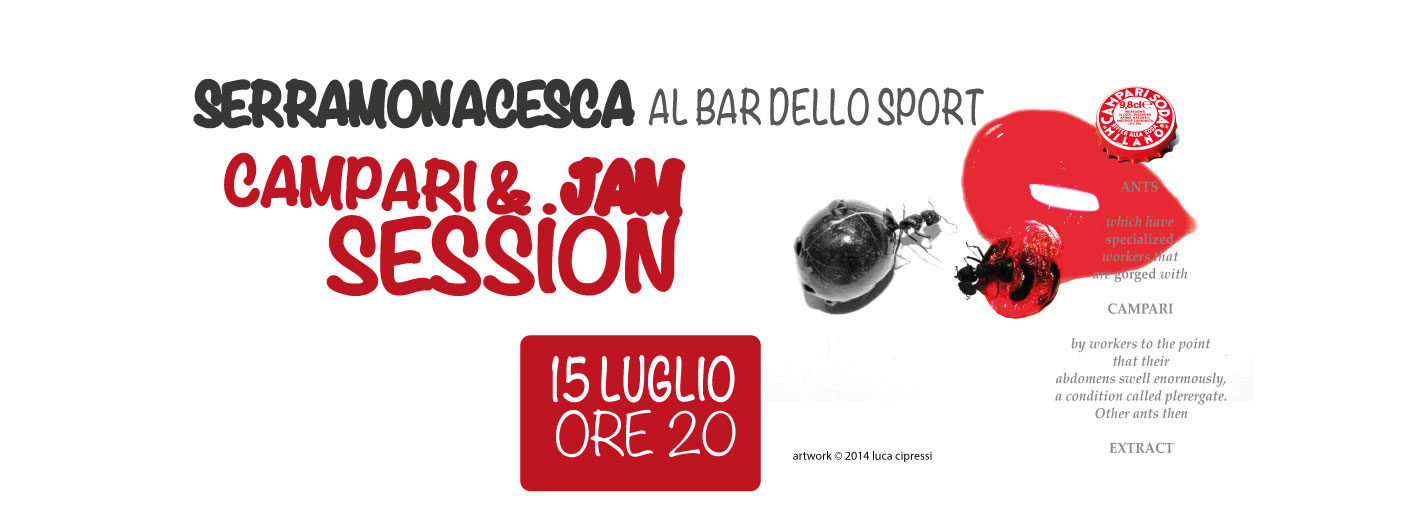
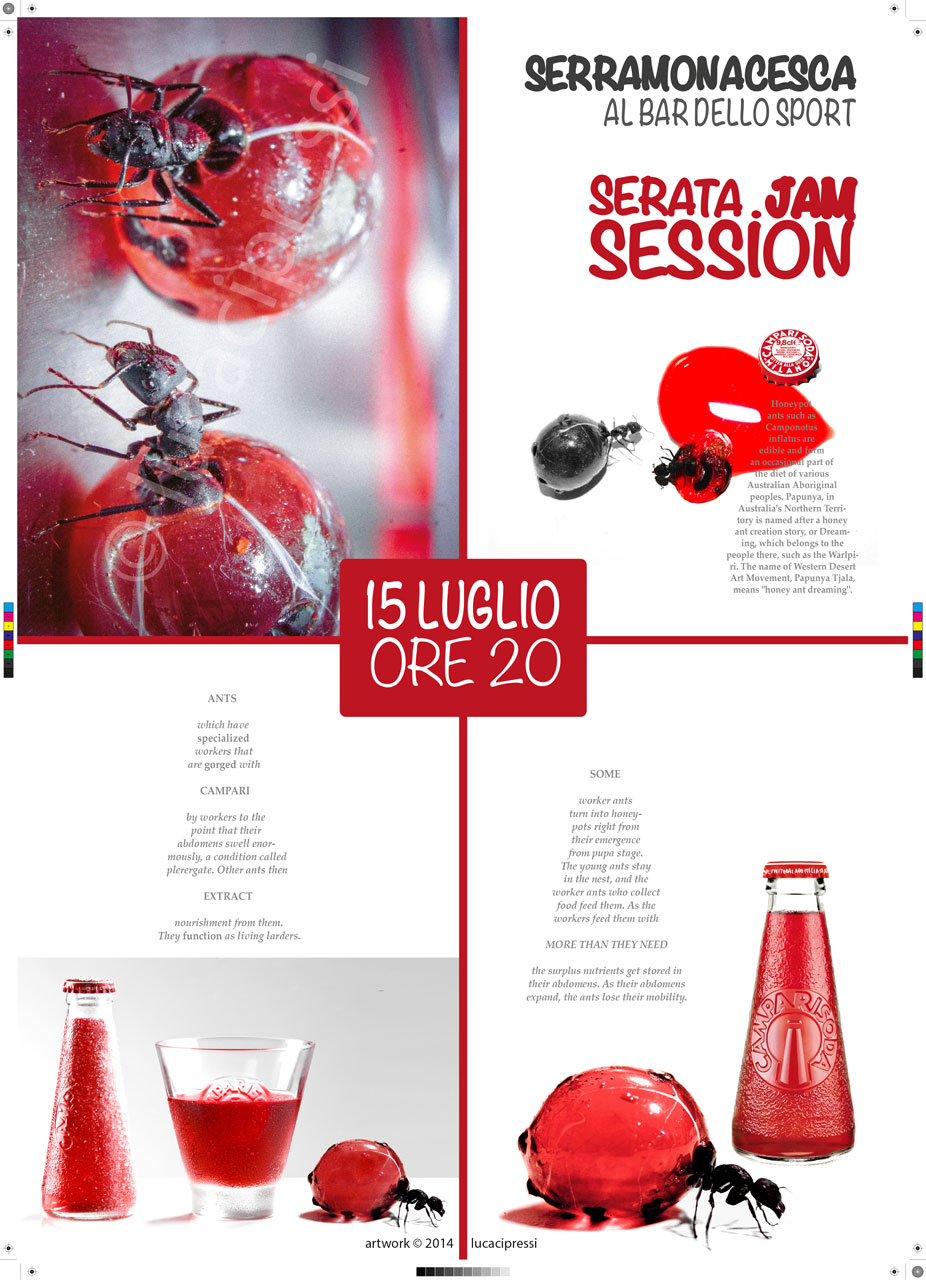
At some point, the idea came up for a Campari-sponsored jam session night. A poster was needed, preferably something more memorable than the usual bar flyer. I was there as a musician, but also as a graphic designer, and I offered to take care of the artwork. By the time I walked back home late that night, the idea had already started to mutate into something stranger and more personal.
The bright red Campari bottles reminded me of a distant image from Central Australia: the honey pot ants, known in some desert traditions as Tjala, whose swollen abdomens store sweet nectar. I had seen and heard about them years earlier while travelling through the Red Centre. In my slightly intoxicated post-Campari imagination, their translucent, nectar-filled bodies became miniature Campari Soda bottles: desert sweetness translated into Italian aperitivo red.
That improbable mental bridge became the core of the flyer.
Red Centre Dreaming: a personal visual memory
The poster’s visual language came from a much deeper memory than the bar night itself. In November 2008, during a journey near Alice Springs and the Central Australian desert, I had the privilege of spending time with René Kulitja and her late husband Richard. René is an important Anangu artist whose work and motifs are strongly connected to Country, memory, movement, and place.
One of the works that made her name known far beyond Australia is connected to Yananyi Dreaming, the Qantas Flying Art Series Boeing 737 livery launched in 2002. The aircraft design was developed by Balarinji using motifs painted by René Kulitja, inspired by the colours and landscape surrounding Uluṟu. The result was one of those rare examples where an aircraft became a moving cultural canvas rather than just a commercial object.
I would never claim to reproduce or own that language. What stayed with me was the memory of its rhythm: dots, paths, circular forms, topographical thinking, and the idea that a landscape can be represented not only as a view, but as a network of stories and movements.
For the Campari flyer, I used that memory in a personal and playful way. The honey pot ants became vivid red creatures, halfway between desert iconography and pop advertising. Photoshop did the rest: saturation, contrast, texture, and repetition turned them into a kind of imaginary Campari Dreaming — a poster born between Central Australia and Central Italy.
Serramonacesca: under the Maiella
Serramonacesca is a small village in Abruzzo, set at the foot of the Maiella massif. It is one of those places where history, walking paths, religious architecture, and mountain silence are all very close to each other. The village is not large, but the surrounding area is dense with places that feel older than their official dates.
The most important landmark is the Abbey of San Liberatore a Maiella , one of the major examples of Romanesque architecture in Abruzzo, with its beautiful stone structure and mosaic floor. Nearby, the remains of Castel Menardo watch over the valley from a panoramic position, while the Hermitage of Sant’Onofrio preserves the memory of a more solitary spiritual life carved into the rock.
The whole area belongs naturally to the wider world of Maiella walking routes. From Serramonacesca you can approach sections of the Sentiero dello Spirito, visit hermitages and abbeys, or continue towards higher and more demanding mountain landscapes. It is a place where a casual bar night can sit surprisingly close to medieval ruins, Benedictine history, and high mountain paths.
Stay and explore: Kokopelli Camping
For anyone wanting to stay nearby, Kokopelli Camping has become one of the best-known small camping retreats in Serramonacesca. It is set in nature at the foot of the Maiella mountains, away from the usual tourist routes, with tent pitches and glamping-style canvas tents available depending on the season.
That setting fits the spirit of the village very well: informal, outdoors, slightly off the beaten track, and close enough to both the mountain trails and the Adriatic coast to make Serramonacesca a surprisingly strategic base for exploring this corner of Abruzzo.
A rainy night to remember
On the night of the event, the weather decided to add its own dramatic contribution. A heavy downpour fell over Serramonacesca, the kind of summer rain that would normally kill the mood before a live event even begins. Somehow, it did not.
The jam session went ahead, and the bar filled with blues, rock, conversation, wet shoes, Campari red, and that very specific energy of a small-town night refusing to be cancelled. The poster, with its impossible red honey ants, had found its natural habitat: not a gallery wall, but a noisy bar, a sponsored drink night, and musicians playing through the rain.
Looking back, the flyer was not just a piece of promotional design. It was a small personal map: Abruzzo, Central Australia, Campari Soda, honey ants, dot-painting memories, friendship, music, and chance — all compressed into one campari-red-themed image.

Further reading
- Qantas Flying Art Series — Yananyi Dreaming
- Balarinji — Qantas Flying Art Series
- Abbey of San Liberatore a Maiella — Italia.it
- Kokopelli Camping — Serramonacesca
Digging for Tjala (honey ants) in the Red Centre
In 2009 I was living between Alice Springs, in the Northern Territory of Australia, and Yulara, the well-known tourist resort about 480 km south-west of Alice Springs, near Uluṟu. At the time I was working as a tour guide/coach operator for AAT Kings, one of Australia’s best-known touring companies. That job gave me many opportunities to spend meaningful time with local people and with Anangu from the Mutitjulu community, next to Uluṟu — learning about the land, listening to stories, and slowly becoming more aware of Tjukurpa, the Dreaming.
Among those Anangu, during a workshop organized by Uluṟu-Kata Tjuṯa National Park, I met René Kulitja — also known as Wanuny Kulitja — and Richard Kulitja, her husband, a respected Aṉangu tour guide associated with Aṉangu Tours. They used to come by my place in Yulara, often accompanied by friends and other tour operators. We would have long conversations, play music together, and sometimes party a little too.
One evening I mentioned that I was driving up to Alice Springs the following morning, and they immediately took the chance to get a lift for some shopping in “the city”. Yulara and Alice Springs are nearly 500 km apart — which, by Australian standards, is almost next door. Going to the Alice meant stocking up on all sorts of extra goodies that were simply not available around Yulara.
The drive was usually rather monotonous, especially once you were used to doing it about once a month. But in their company, and in the intimacy of the car, the journey became something else. They shared very special stories about the Dreaming and their ancestors. We spoke in English, of course, but they often slipped into their own language, especially when describing the nature, the land, and the places around us.
Once we reached Alice Springs, we went grocery shopping at Woolworths. Before getting to the checkout, I noticed Richard rummaging inside a freezer for quite a while. When I got closer, I realized he was digging around for frozen kangaroo tails — yep. He smiled and told me we were going to eat them in the bush north of Alice. Why north, I asked. Because René wanted to show me how to find Tjala, the honey pot ants.
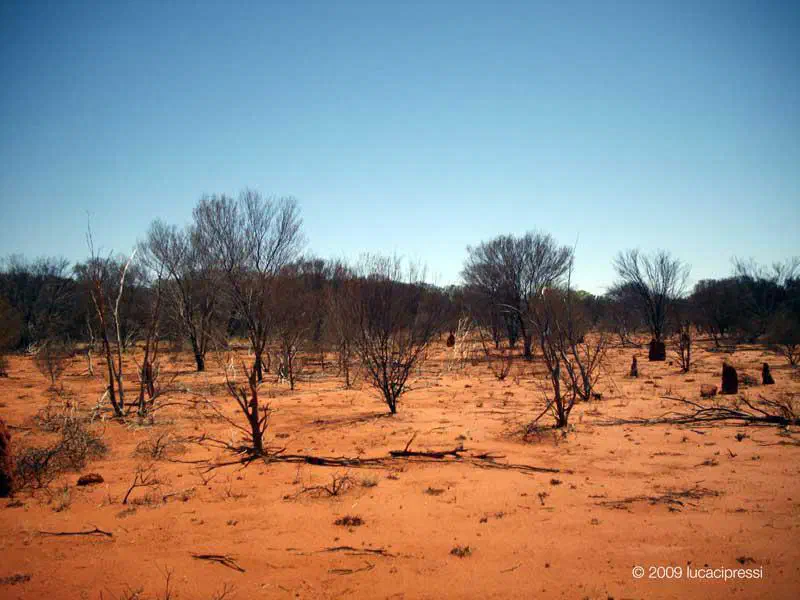
So we drove north for a hundred kilometres or so — much of it off-road — until René told me to stop the car. Earlier that morning in Yulara she had loaded some bags into my car, and inside one of them was a short metal digging shovel. She took her wana, the women’s digging stick, along with the shovel, and walked off into the bush. I followed her through a maze of mulga trees for quite a while, until she suddenly stopped and asked me to point towards the car. I was completely lost. She was not. She pointed in a totally different direction from the one I had guessed, then kept walking.
Eventually we reached a place that felt subtly different. The vegetation had changed slightly — even I could tell that much. René kept observing signs around tree trunks and roots. Every now and then she would drive the shovel into the sandy red soil, strike a couple of times, shake her head, and move on.
Richard was far behind us by then. I could not see him, but I could hear him whenever he deliberately made noise — probably breaking branches while looking for mingulpa, the wild tobacco. René and I were downwind from him, so the wind carried the sounds in our direction.
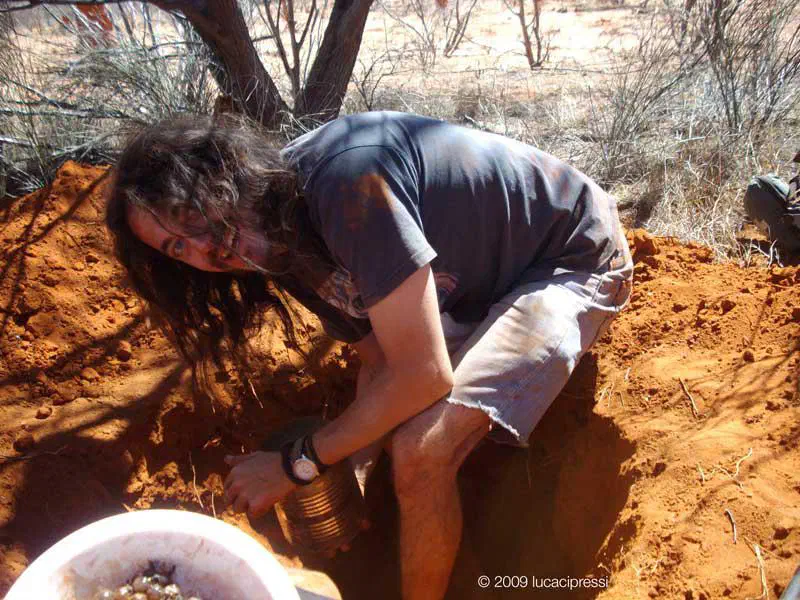
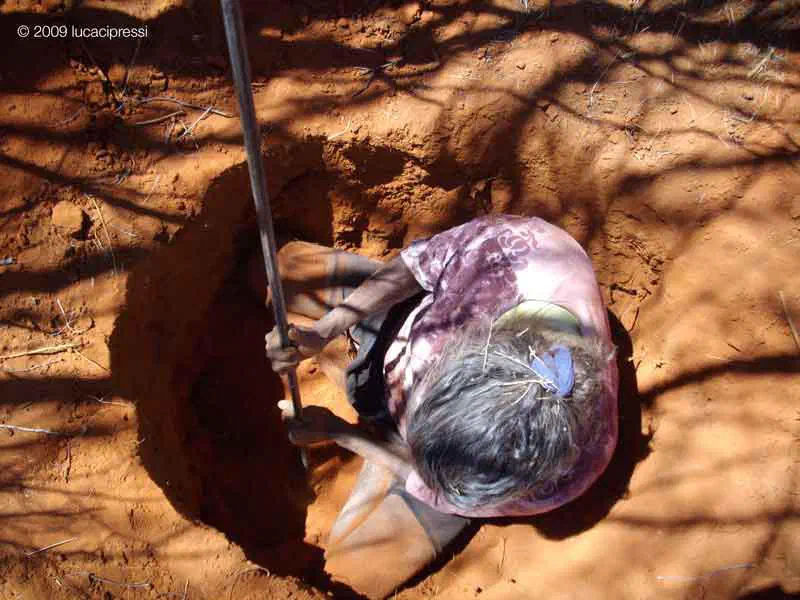
After a few attempts, René signalled to me. She had begun digging with more purpose. As I got closer, she pointed to certain marks on the ground and explained that this was the right place for Tjala. She dug a large hole, big enough for her to fit inside. She was no longer young, so I offered to help.
A loud cackle came from somewhere behind us. Richard, standing about forty metres away, could not believe that a man was doing a woman’s job. He was taking the piss, as they say in Australia — mocking me with great delight.
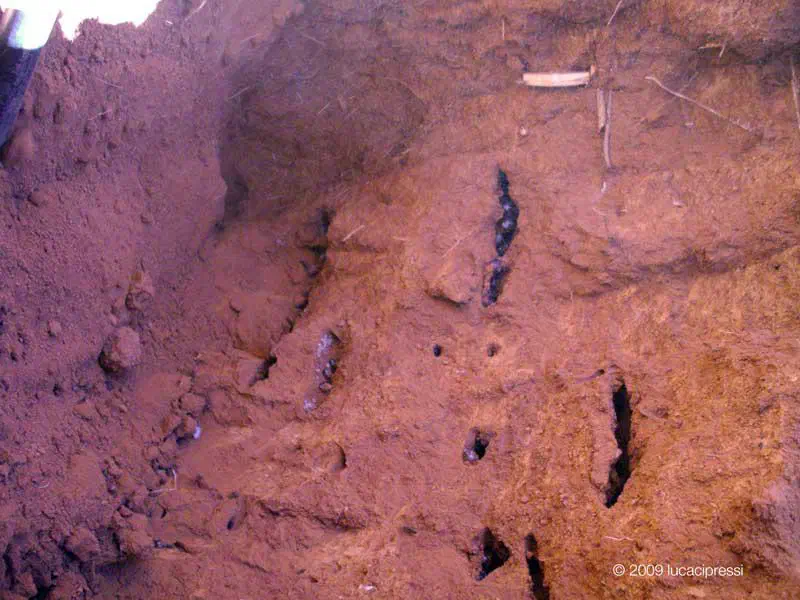
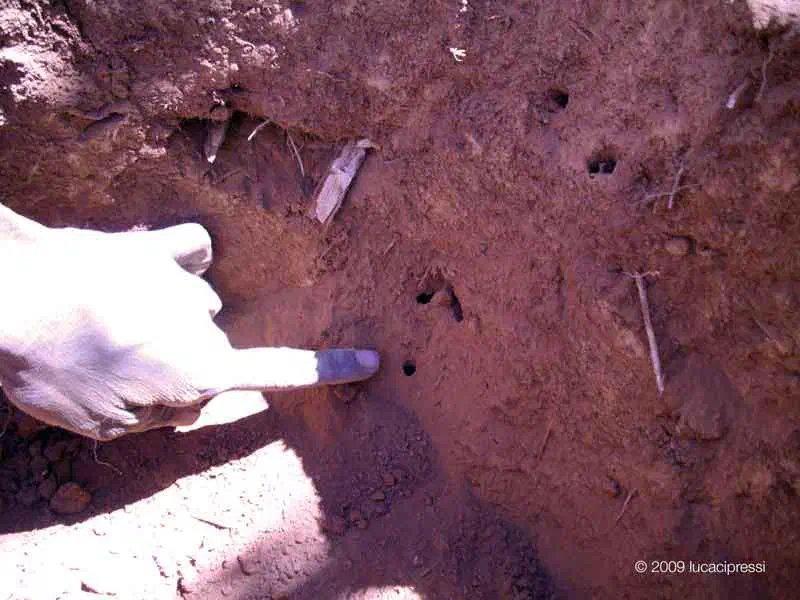
I did not mind. I was happy to help. After a while René took the shovel back from my hands and began carefully scraping certain areas inside the cylindrical hole. Soon we started seeing ants running away — not millions, but surely thousands. She ignored most of them and moved a handful of sand, with some ants in it, to another spot. The ants followed. Perhaps she had moved the queen.
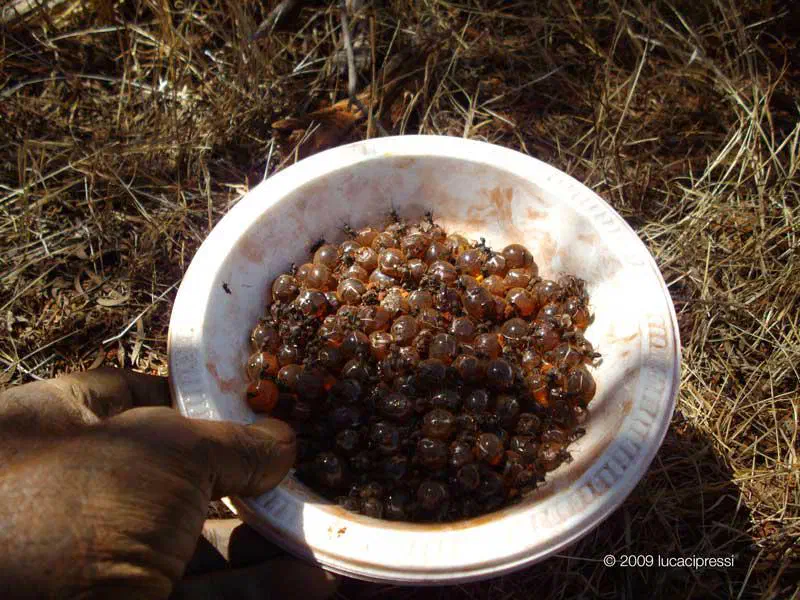
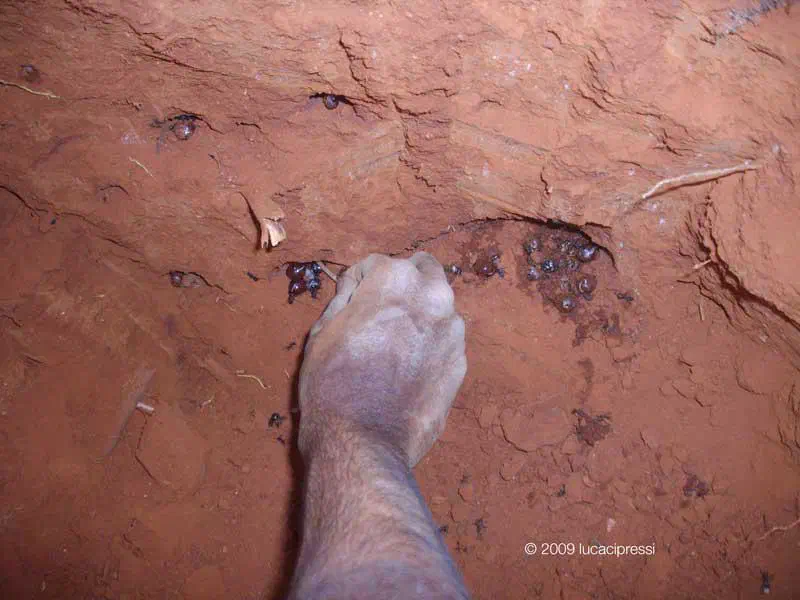
Then, with her bare hands, she gently opened the sandy walls, and to my surprise many small hollow chambers appeared before my eyes. Inside each chamber, hanging from the ceiling, were fat-bottomed ants. Their abdomens were swollen with yellow honey. René took a stick and collected a small dishful of them. The little creatures could not run away because of their heavy honey pots.
She picked up one of the ants with her fingers, holding it gently from the front of the body, brought its abdomen close to her mouth, and popped the honey pot with her lips. Then she invited me to do the same. When I did, the sweetest honey-like juice poured into my mouth. Richard did the same, and we collected a few more Tjala to take with us.
By then we all knew where the car was, so we walked back. Richard lit a small bonfire with the wood he had collected — no mingulpa, unfortunately. We stayed there until the kangaroo tails were cooked and the sun began to set. I listened to more Dreaming stories, and René pointed to the Seven Sisters in the sky. She had a special connection with that story, which is remarkably close to the Greek myth of Orion the hunter, his dogs, and the Seven Sisters — the Pleiades. In the southern hemisphere they are visible during the summer.
Satisfied, we cleaned everything up and got back into the car. We spent the night in Alice Springs, and the next day we were back on the road to Yulara. I did not know then that it would be the last time I would see Richard.
More than a year afterwards, I returned to René’s homeland. I wanted to buy some of her paintings, and she and her relatives happened to be interested in my car.
Deal.
They drove me back to Yulara, then took the car back with them. I still have one of René’s paintings hanging in my home today. Whenever I look at it, I am carried back to those bright desert days, and I can still hear Richard laughing.
© 2026 Luca Cipressi - Milletgrain. All rights reserved.
This text and the accompanying photographs are part of a personal memoir and may not be reproduced, republished, or used commercially without permission. Cultural note: this is a personal recollection of time spent in Central Australia and is not intended to document, explain, or appropriate Anangu cultural knowledge. Any errors or misunderstandings are my own.