Bass Guitar Preamps Compared: Bartolini MK-1 vs Markbass MB-1
Reverse-engineering two Cort active bass circuits from the solder side to the player’s hands
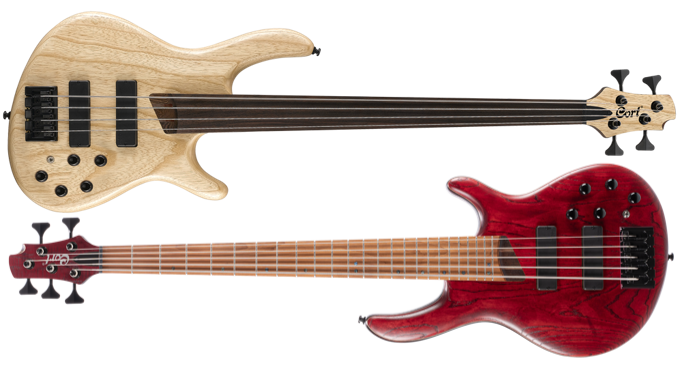
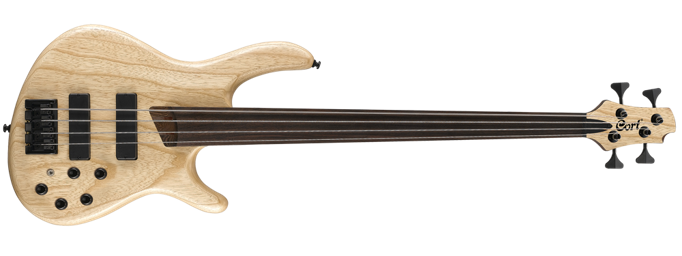
Cort Artisan B4FL+AS with Markbass MB-1 preamp
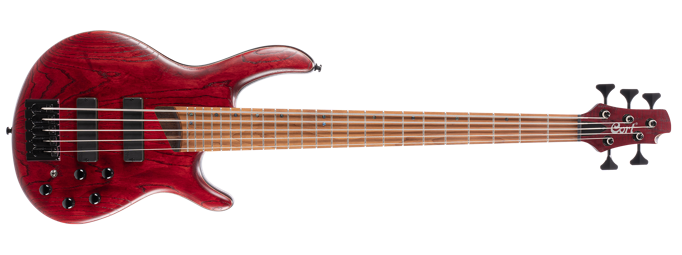
Cort Element B5 with Bartolini MK-1 preamp
Two basses, a very similar control layout, two rather different electronic philosophies.
This article compares two active onboard preamps commonly found in mid-tier Cort bass guitars: the Bartolini MK-1 and the Markbass MB-1. At first glance they appear to offer the same practical feature set: master volume, pickup balance, three-band EQ, active/passive switching and a single 9V battery. From the player’s point of view the instruments also invite a similar workflow: set the pickup blend, shape the low/mid/high response, and use the mini-toggle when a more direct sound is needed.
Inside the control cavity, however, the two systems do not tell the same story.
The Bartolini MK-1 fitted to my Cort B5 Element is compact, inexpensive, efficient and perfectly serviceable, but its “passive” switch deserves a closer look: in my instrument it behaves as an EQ bypass, not as a true battery-independent passive mode. The Markbass MB-1 fitted to the Cort Artisan B4FL+AS, on the other hand, is advertised and wired as a more complete active/passive solution. For a fretless bass this matters, because the instrument is often expected to move between very natural, woody lines and more focused modern tones without losing the immediacy of the fingers on the string.
The aim here is not to declare a universal winner. It is to document what is inside, what the switching really does, and what these design choices mean for players, repairers and curious electronics builders.
Why compare these two preamps?
Cort has used both Bartolini and Markbass electronics across several Artisan and Action-series instruments. The Cort B5 Element is specified with Bartolini MK-1 pickups and a Bartolini MK-1 preamp, while the older Cort B4FL Plus AS was sold with Bartolini MK-1 pickups and a Markbass MB-1 EQ. Other Cort models also mention the MB-1 as a three-band active EQ with volume, pickup balance and active/passive switching.
That makes the comparison particularly interesting because the pickups are not radically different in family or format. The two instruments are not identical—one is a five-string fretted bass, the other a four-string fretless—but they share enough of the same design vocabulary to make the preamp differences audible and technically meaningful.
There is also a practical reason. Replacement onboard preamps are often chosen by reading a short product description or watching a demo video, while the real day-to-day value of an onboard circuit depends on details that are easy to miss: input impedance, headroom, bypass topology, battery behaviour, switch wiring, connector pinout, noise, and how gracefully the bass behaves when the battery dies.
Instrument specifications
| Specification | Cort B5 Element | Cort Artisan B4FL+AS |
|---|---|---|
| Construction | Bolt-on | Bolt-on |
| Body | Mahogany with ash top | Swamp ash |
| Neck | 5-piece walnut and panga panga | Maple/wenge; 1F 20.5 mm, 12F 22 mm |
| Fretboard | Roasted maple | Panga panga |
| Fretboard radius | 15.75" / 400 mm | n.a. |
| Frets | 24 | Fretless, two octaves |
| Scale | 34" / 864 mm | 34" / 864 mm |
| Tuners | Hipshot Ultralite | Hipshot Ultralite |
| Bridge | MetalCraft M5, 18 mm spacing | EB12(4) |
| Pickups | Bartolini MK-1 set | Bartolini MK1-4/F and MK1-4/R |
| Electronics | Bartolini MK-1 | Markbass MB-1 |
| Hardware colour | Black | Black |
| Strings | D’Addario EXL170-SSL | D’Addario EXL165, 105–045 |
Shared user controls
- Master volume
- Pickup balancer
- Three-band EQ in active operation
- Active/passive or EQ-bypass mini-toggle, depending on the circuit
- 9V battery supply
Architecture at a glance
| Function | Markbass MB-1 | Bartolini MK-1 |
|---|---|---|
| Typical Cort layout | Volume, balance, bass, mid, treble, active/passive switch | Volume, balance, bass, mid, treble, mini-toggle |
| Switch behaviour in this comparison | True passive fallback in the B4FL+AS installation | EQ bypass only in the B5 Element installation |
| Battery-less operation | Yes, in passive mode | No, in the inspected wiring |
| Public schematic availability | Not found | Not found as an official document; reverse-engineered here from the board |
| Public product information | Mostly Cort model descriptions and later Markbass onboard-preamp documentation | Cort and Bartolini/Cort product descriptions, plus user reverse-engineering |
| Practical personality | More flexible live fallback, smoother active/passive transition | Compact, efficient, but less forgiving when the battery fails |
The two preamps appear in instruments with similar connector and control strategies, and in many cases they are close enough mechanically to tempt direct replacement experiments. Electrically, however, the switching strategy is the first major difference.
The Bartolini circuit keeps the signal inside an active system even when the EQ is bypassed. The Markbass implementation found in the B4FL+AS is more player-friendly in the traditional sense: it allows the bass to continue working as a passive instrument when required.
That single design decision changes the way the instrument can be trusted on stage.
The active/passive question
The phrase “active/passive” is often used rather loosely in bass specifications. In a strict sense, a passive mode should route the pickups to the output without needing battery-powered amplification. Tone controls may or may not remain available, depending on the design, but the instrument should still produce sound with no battery installed.
An EQ bypass, by contrast, may only remove the equalizer from the signal path while leaving the input buffer, mixer or gain stage powered. This can sound more direct, but it is not a battery-independent emergency mode.
This distinction is not academic. A true passive mode gives a bassist three practical advantages:
- Battery failure fallback — the bass still works if the battery dies.
- A different impedance relationship — the pickups interact more directly with the cable and amplifier input.
- A more familiar passive feel — especially relevant for fretless playing, where dynamics, vibrato and right-hand articulation are central to the instrument’s voice.
For a fretted five-string modern bass, an always-buffered signal can be perfectly acceptable. For a fretless four-string swamp-ash instrument, the option to remove the active layer can feel musically more important.
Bartolini MK-1 reverse engineering
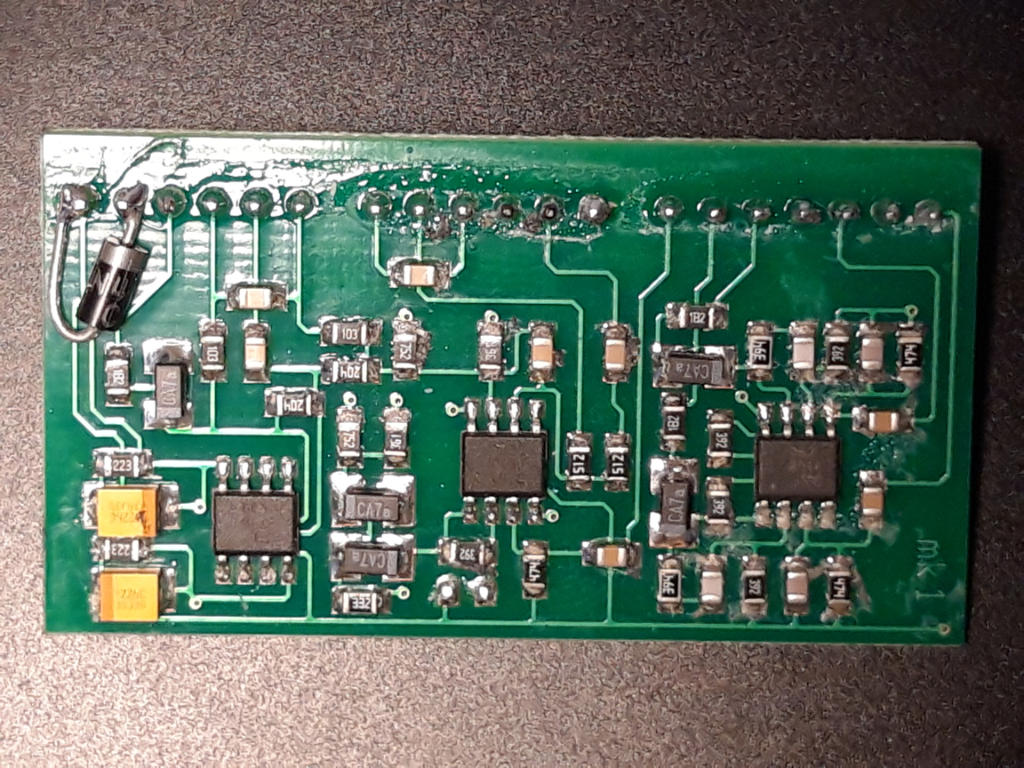
The Bartolini MK-1 board is built entirely with surface-mount components on a compact PCB with minimal silkscreen information. It is clearly designed for factory installation: small, repeatable, cost-efficient and easy to fit in a crowded control cavity.
The circuit uses three TL062 dual op-amps in JRC packages. The TL062 is a low-power JFET-input dual operational amplifier, and it makes sense in a 9V battery-powered instrument: current consumption matters, and a bass preamp should not punish the player with short battery life. The trade-off is that low-power op-amps are not always the quietest or most headroom-rich option available, especially when asked to handle large transients from modern pickups.
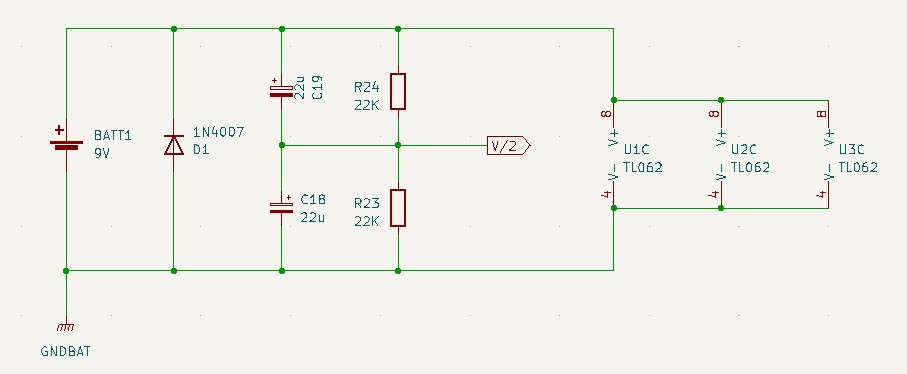
A polarity-protection diode is soldered across the battery terminals. Two tantalum capacitors help stabilize the V/2 virtual ground derived from the 9V supply. This half-supply reference is necessary because the audio signal must swing around a midpoint: with a single 9V battery there is no negative rail, so the op-amps need an artificial centre point.
This is normal practice in compact onboard preamps, but it also means the quality of the bias network matters. Any noise or instability on the V/2 node can leak into the audio path.
MK-1 signal path
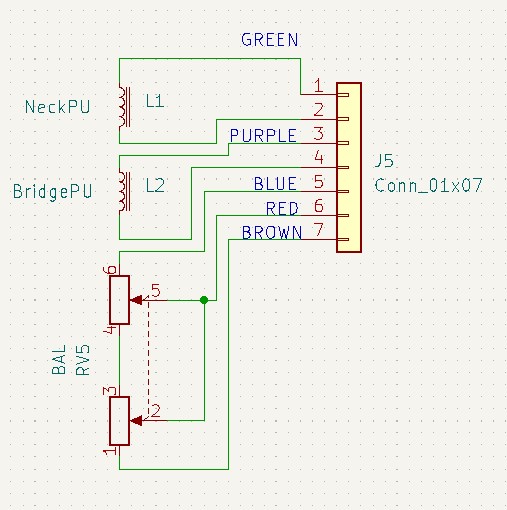
The passive pickups are first routed through the pickup-balance potentiometer. The blended signal then enters a unity-gain op-amp stage before reaching the switch. From there the signal is routed either to the output with the EQ bypassed, or into the three-band active equalizer.
In other words, the switch changes the tone-shaping path, not necessarily the entire active/passive identity of the instrument.
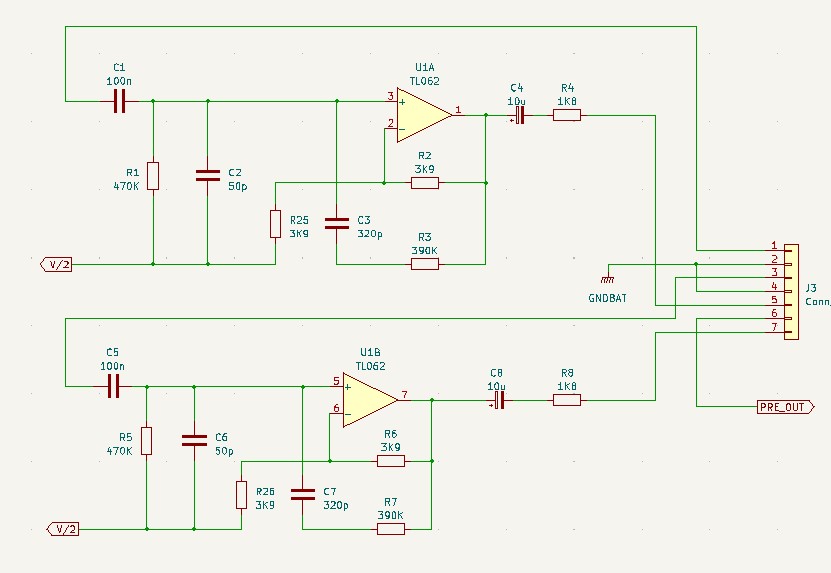
The input coupling capacitors are 100 nF. Together with the input resistance they form a high-pass filter. This is a common way to remove DC and subsonic content before amplification, but the exact cutoff frequency depends on the impedance around the stage.
A larger coupling capacitor—1 µF or more, for example—would extend the low-frequency response. That is not automatically an improvement. Bass instruments generate mechanical thumps, fingerboard knocks, handling noise and low-frequency energy that may not be musically useful. Extending the response too far downward can make a bass feel bigger in isolation while making it harder to control in a mix.
The unused op-amp section
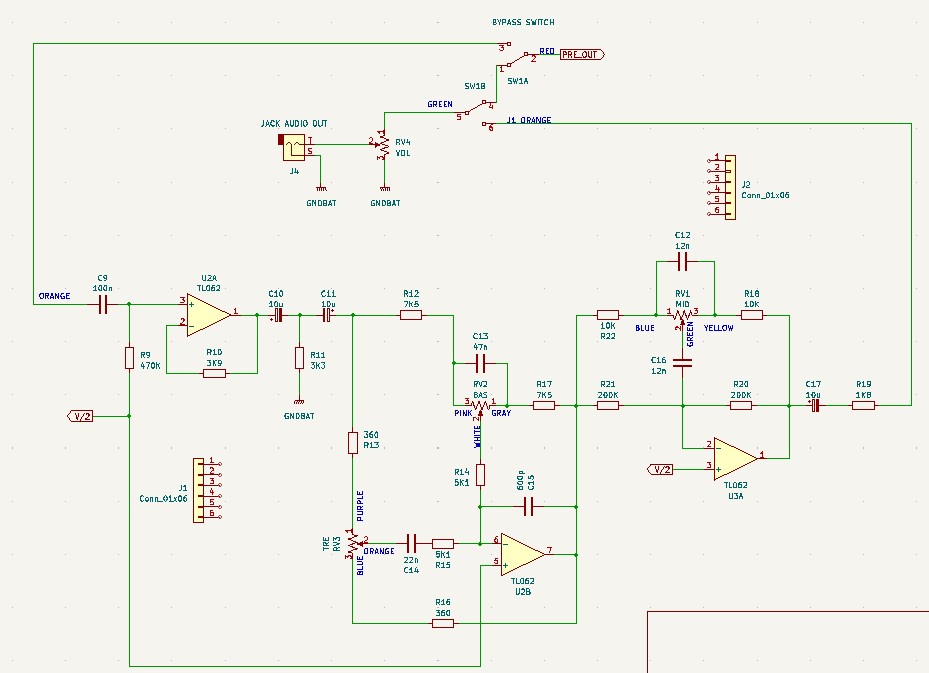
One notable detail is an unused op-amp section with floating inputs. From an engineering standpoint this is not ideal. Unused op-amp sections should generally be parked in a defined, stable configuration—often as a unity-gain follower with the non-inverting input tied to a suitable reference—rather than left free to pick up noise, RF energy or unpredictable bias conditions.
In a bass guitar this may never create an audible problem. The circuit is small, battery-powered and shielded by the control cavity. Still, it is one of those small design choices that reveals the cost-optimized nature of the board.
What the Bartolini MK-1 gets right
The MK-1 is not a bad preamp. It is compact, efficient and easy to manufacture. It offers a useful three-band EQ and gives many affordable instruments a more versatile voice than a purely passive circuit would. Its voicing can be musical, and in the right bass it delivers a strong modern sound.
The problem is mainly semantic and practical: when a player reads “active/passive”, they may expect a traditional passive fallback. In this inspected installation, that is not what the circuit provides.
Markbass MB-1: what can be confirmed publicly
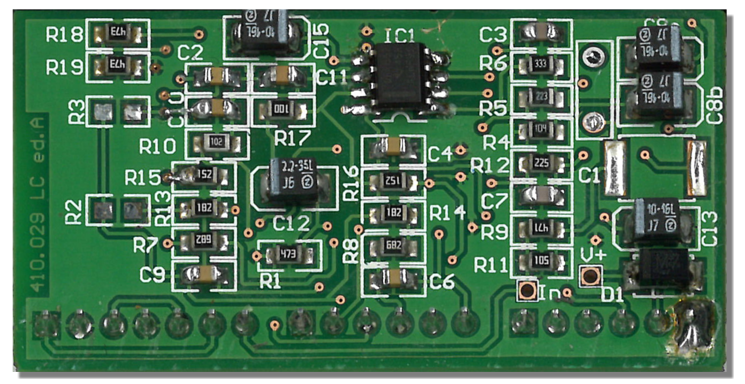
The Markbass MB-1 is more difficult to document from public sources than the Bartolini MK-1 because detailed schematics and component-level service information do not appear to be publicly available. Most available information comes from Cort model pages, product announcements, retailer descriptions and Markbass’s later aftermarket onboard preamp documentation.
Cort describes the MB-1 EQ as a natural and transparent boost designed not to mask the organic character of the instrument. The typical Cort control set includes master volume, pickup balance, three-band EQ and an active/passive switch. A 2016 Cort Action DLX AS announcement describes the MB-1 EQ as a three-band preamp with pickup balancer, master volume and active/passive conversion switch.
Those statements are not a schematic, but they do confirm the intended role of the module: a compact onboard preamp that can provide active tone shaping while preserving access to a passive-style signal path.
MB-1 versus Markbass MB Instrument Pre
Markbass currently sells an aftermarket onboard preamp called the MB Instrument Pre. It should not be treated as automatically identical to the Cort OEM MB-1, but it is useful context because it shows what Markbass considers important in this class of circuit.
The Markbass/Mark Store product information for the MB Instrument Pre highlights:
- compact size suitable for most instrument cavities;
- 9V or 18V operation;
- very low current consumption, specified at about 700 µA with a 9V supply;
- flexible wiring options such as volume/blend/three-band EQ, volume/volume/three-band EQ, or volume/blend/tone with active/passive operation;
- a design goal of minimizing volume jumps when switching between active and passive modes;
- technical features including 1.1 MΩ input impedance, low/mid/high EQ controls, 47 × 32 × 10 mm dimensions and approximately 35 g weight.
Some retailer specifications for the MB Instrument Pre list the three EQ centres as approximately 85 Hz for bass, 500 Hz for midrange and 8.5 kHz for treble, with ±15 dB boost/cut. These values are useful reference points for measurement planning, but they should not be copied onto the MB-1 without verification. OEM circuits can differ from aftermarket modules, even when the control philosophy is similar.
Practical sound and playing implications
The electronic differences become especially interesting when moving from a fretted five-string bass to a fretless four-string.
A fretted active five-string often benefits from a tighter, more polished output. The preamp can help keep the B string controlled, add definition to slap or pick articulation, and compensate for amplifier or room conditions. In that context, the always-buffered behaviour of the MK-1 installation may not be a serious drawback.
A fretless bass is a different animal. The player often wants to hear more of the direct relationship between finger pressure, string bloom, intonation, vibrato and decay. A true passive mode can be valuable because it lets the instrument breathe in a simpler way. The active mode remains available for extra focus, but it is not forced onto the signal path.
This is where the MB-1 implementation feels conceptually stronger: not because Markbass is automatically “better” than Bartolini, but because the switching behaviour gives the player a broader range of usable states.
Serviceability and modification notes
Neither board is a luxurious boutique module built for repeated hand modification. Both belong to the world of compact factory electronics. Still, there are some practical differences worth noting.
The MK-1’s SMD construction makes it small and efficient but not very inviting for casual component swaps. Replacing coupling capacitors, changing EQ values or improving op-amp handling is possible, but it requires proper SMD tools and a good reason to intervene.
The MB-1 board, judging from the inspected PCB and the way it is used in the B4FL+AS, appears more attractive as a practical replacement or upgrade candidate when a true passive fallback is desired. The important caveat is that wiring compatibility should always be checked with a meter before assuming that two visually similar preamps share the same connector pinout.
For any preamp swap, I would recommend documenting at least:
- pickup hot and ground wiring;
- battery positive and switched ground;
- jack wiring;
- switch poles and throw behaviour;
- pot values and taper;
- shielding continuity;
- whether passive mode works with the battery removed.
That last test is the simplest and most revealing: remove the battery, plug the bass into an amplifier, and check whether the instrument still produces a signal.
Measurement plan for a future update
The next logical step is to move from visual reverse engineering to measurement. A useful comparison would include:
| Measurement | Why it matters |
|---|---|
| Passive output level | Establishes the pickup baseline before active electronics |
| Active flat response | Reveals whether “flat” is genuinely neutral |
| Bass/mid/treble boost and cut curves | Confirms centre frequencies, Q and gain range |
| Output impedance | Affects cable loading and interaction with pedals or amplifiers |
| Noise floor | Important for studio use and high-gain amplification |
| Headroom at 9V | Determines how well the preamp handles strong transients |
| Battery current | Predicts real-world battery life |
| Active/passive level difference | Shows whether switching can be done mid-performance without a volume jump |
The Markbass MB Instrument Pre documentation explicitly mentions the goal of subtle volume changes between passive and active operation. That is exactly the kind of claim worth measuring on the MB-1, because it affects live usability more than any marketing adjective.
Conclusion
The Bartolini MK-1 and Markbass MB-1 occupy a similar space: compact onboard electronics for affordable-to-midrange basses with modern control layouts. Their difference lies less in the number of knobs and more in the architecture behind those knobs.
The Bartolini MK-1 is a compact, efficient and economical active circuit. It provides a usable three-band EQ and a direct-sounding bypass option, but in the inspected Cort B5 Element it does not provide a true battery-independent passive mode. Its use of an unused floating op-amp section is also a small but legitimate engineering criticism.
The Markbass MB-1 is harder to document at schematic level, but its Cort implementation is more convincing from a player’s perspective because it offers a real passive fallback. In a fretless instrument, that is not just an emergency feature; it is part of the musical vocabulary of the bass.
For me, this comparison becomes less about brand preference and more about honesty of switching. A switch labelled or understood as passive should ideally be passive in the practical sense: pickups to output, no battery required. Anything else may still be useful, but it should be called what it is—an EQ bypass.
Markbass, Marco De Virgiliis and a local Abruzzo connection
There is a pleasant geographical footnote to this comparison: Markbass is not a distant anonymous brand in this story. Its headquarters are in San Giovanni Teatino, Chieti, in Abruzzo—very close to my own area.
Marco De Virgiliis founded Markbass after years of work in electronics, amplification and speaker design. A Premier Guitar profile traces the story back to De Virgiliis building bass amps before the Markbass name existed, later developing the Parsek/Audiophile period and eventually launching Markbass in 2001. The same profile also points to an important technical theme in the brand’s identity: lightweight bass amplification and the early adoption of neodymium speakers in bass cabinets.
The company’s modern public identity still revolves around the same core ideas: tone, reliability, lightweight construction, Italian production and a strong relationship with working musicians. Markbass’s investor materials describe the company as a Made-in-Italy brand with international distribution in more than 60 countries, while the official team page places the company at Via Po in San Giovanni Teatino, Chieti.
For a bass player and electronics tinkerer in Abruzzo, it is a nice reminder that some very influential bass technology was developed just around the corner.
Useful links
- Markbass official website
- Markbass MB Instrument Pre
- Mark Store — MB Instrument Pre technical features
- Markbass team and contact page
- Markbass Investors Center
- Premier Guitar — Builder Profile: Markbass
- Thomann Blog — MarkBass and DVMark factory tour in San Giovanni Teatino
- Cort B5 Element official page
- Cort B4FL Plus AS archived product page
- Vintage Guitar — Cort launches Action DLX AS with Markbass MB-1 EQ